

Peter Thiel occupies a distinctive position among the technology entrepreneurs and investors examined in this series. His influence extends well beyond the companies he helped establish or finance, reaching into political ideology, government administration, and the growing concentration of technological power. The astrological connection to the current Tech Bros series is unusually precise: Thiel’s natal Moon at 0°07′ Aquarius lies within 22 arcminutes of the Jupiter–Saturn conjunction at 0°29′ Aquarius on 21 December 2020. Both occupy the Egyptian bound of Mercury/Aquarius, whose contemporary manifestations include digital authoritarianism and the proposition that code is law—the replacement of conventional legal and administrative discretion by rules embedded in technological systems. From PayPal’s electronic payments network to Palantir’s intelligence software, Thiel’s career has repeatedly intersected with these themes.
Another astrological connection reaches back to his birth on 11 October 1967, just seven days before a total lunar eclipse in Aries. Nearly two decades later, the Aries–Libra eclipse cycle returned in the spring of 1987, coinciding with a controversy over the intellectual foundations of American higher education. Allan Bloom’s The Closing of the American Mind, published in early April, challenged the growing influence of moral relativism and the retreat from classical philosophy in university education. The book became a national bestseller, bringing arguments previously confined largely to academic circles into public debate. As examined in an earlier Regulus Astrology article on Allan Bloom, the eclipse cycle provides an important framework for understanding his sudden emergence as a nationally recognized intellectual.
Peter Thiel rode the same eclipse wave. On 9 June 1987, while an undergraduate at Stanford University, he launched The Stanford Review, a student newspaper whose criticisms of multiculturalism, academic conformity, and the proposed dismantling of the Western Culture curriculum closely paralleled Bloom’s concerns. The two men approached these controversies from different positions, but both challenged the growing acceptance of moral and cultural relativism within American universities. For Thiel, the campaign became his first claim to public prominence. His reputation as a combative critic of the emerging campus diversity movement culminated in the publication of The Diversity Myth, co-written with David Sacks in 1995, and an appearance on William F. Buckley Jr.’s Firing Line that December.
The student polemicist subsequently became a financier of technological enterprises, accumulating enormous wealth through PayPal, Facebook, Palantir, and Founders Fund. Yet the ideological concerns that first brought him public attention never entirely disappeared. His criticism of established institutions evolved into a preference for privately organized systems of authority, powerful entrepreneurial leaders, and technological alternatives to conventional government administration. This study examines the rectified horoscope behind that progression, connecting Thiel’s early intellectual battles with his later financial achievements, political interventions, and role in the emerging digital order.
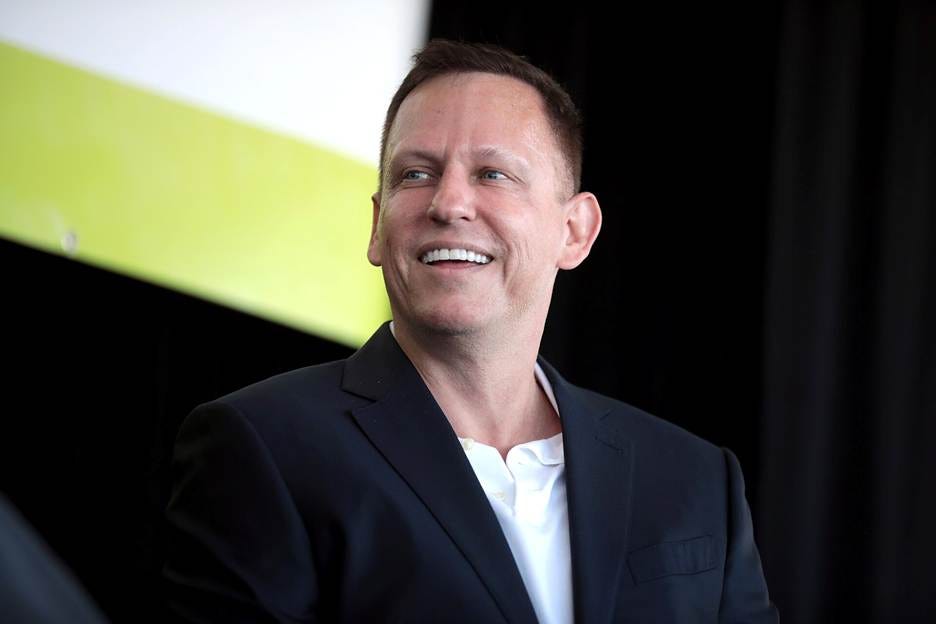
Peter Andreas Thiel was born on 11 October 1967 in Frankfurt am Main, West Germany. His family immigrated to the United States during his infancy, subsequently living in South Africa and South West Africa (present-day Namibia) before settling in Foster City, California, in 1977. The son of a chemical engineer, Thiel developed early interests in mathematics, chess, science fiction, and philosophy. He attended Stanford University, where he encountered the philosophy of René Girard, particularly his theory of mimetic desire, which would become an enduring influence on Thiel’s understanding of competition, social behavior, and institutional power.
In June 1987, Thiel co-founded The Stanford Review, a conservative and libertarian student newspaper established amid controversy over Stanford’s Western Culture curriculum. The newspaper opposed what Thiel regarded as political conformity within the university and challenged proposed changes to the traditional humanities curriculum. These debates coincided with the national reception of Allan Bloom’s The Closing of the American Mind, published earlier that year. Thiel graduated from Stanford with a philosophy degree in 1989 and subsequently earned a law degree from Stanford Law School in 1992. After briefly working as a judicial clerk and securities lawyer, he entered derivatives trading at Credit Suisse. In 1995, Thiel and fellow Stanford graduate David Sacks published The Diversity Myth, a critique of Stanford’s multicultural policies, affirmative action, and campus political culture. The book brought Thiel national attention, including an appearance on William F. Buckley Jr.’s Firing Line in December 1995.
Thiel established his first independent investment business, Thiel Capital Management, in 1996. Two years later, he joined software engineer Max Levchin in founding Confinity, which developed the electronic payments service PayPal. Confinity merged with Elon Musk’s X.com in March 2000, but disagreements over management and technology led to Musk’s replacement by Thiel as chief executive in September of that year. PayPal went public in February 2002 and was acquired by eBay for approximately $1.5 billion in October 2002, establishing Thiel’s first substantial technology fortune. His financial success reflected not only his founding and executive role but also a series of early equity acquisitions, including additional shares purchased through company financing before the public offering.
Following PayPal’s acquisition, Thiel established Clarium Capital, a global macro hedge fund, and expanded his investments in emerging technology businesses. In 2003, he co-founded Palantir Technologies, a company developing software for intelligence analysis, data integration, and eventually military and commercial applications. The following year, he became Facebook’s first major outside investor, committing $500,000 to the social network founded by Mark Zuckerberg. In 2005, Thiel helped establish Founders Fund, a venture-capital firm that invested in companies including SpaceX and subsequently Anduril. These investments placed him at the center of a network of entrepreneurs whose businesses would reshape electronic payments, social media, aerospace, and government technology.
Thiel’s contrarian investment strategy produced both substantial gains and severe reversals. At Clarium Capital, he correctly anticipated important elements of the financial crisis that began in 2007, initially profiting from positions reflecting his skepticism toward housing, financial leverage, and prevailing market valuations. The fund’s assets reached approximately $7.2 billion in 2008. However, Thiel subsequently positioned for a recovery in technology equities before the market had established a durable bottom, while other macroeconomic positions also moved against him. These premature investments and unsuccessful market forecasts reversed much of Clarium’s earlier gains. Continued losses and investor withdrawals reduced the fund’s assets by approximately 90% from their peak by early 2011. Thiel increasingly concentrated on private technology investments through Founders Fund and related firms. His early Facebook investment nevertheless produced enormous financial gains. During Facebook’s May 2012 public offering and subsequent August share sales, Thiel and associated investment entities disposed of shares generating more than $1 billion in gross proceeds. His investment activities also included early private-company shares held through a Roth IRA, whose reported value had reached approximately $5 billion by 2019.
Alongside his financial activities, Thiel developed an increasingly public critique of conventional education, competitive markets, and established political institutions. In 2010, he announced the Thiel Fellowship, offering young entrepreneurs $100,000 over two years to pursue projects outside the university system. Although intended as an alternative to conventional higher education, the program provided relatively little supervision or structured training, particularly during its early years. According to Max Chafkin’s account in The Contrarian, numerous participants struggled to translate their grants into sustainable businesses or substantial professional achievements, while several returned to conventional education. A smaller number, including Ethereum co-founder Vitalik Buterin, achieved considerable success, although the extent to which the fellowship itself contributed to those outcomes remains debatable. Thiel’s 2014 book Zero to One, written with Blake Masters, argued that technological progress depended upon creating new products and markets rather than merely competing within existing ones. Thiel maintained that successful businesses should seek durable monopolistic advantages, an idea that became central to his investment philosophy. In March 2015, he joined Y Combinator as a part-time partner, extending his influence over younger technology entrepreneurs.
In May 2016, Thiel was publicly identified as the secret financial backer of Hulk Hogan’s litigation against Gawker Media, revealing a years-long effort to pursue legal action against a publisher with which he had a longstanding dispute. Two months later, he endorsed Donald Trump at the Republican National Convention, becoming one of the most visible technology investors supporting Trump’s presidential campaign. Following Trump’s election, Thiel participated in the presidential transition and helped establish connections between the incoming administration and Silicon Valley. However, his initial expectations for the administration, particularly concerning deregulation and institutional reform, were not fully realized. He became increasingly disillusioned with the limited results of direct political involvement and gradually withdrew from an active advisory role. His political engagement subsequently resumed through a different strategy: financing individuals whose careers and ideological commitments he had helped cultivate. In 2021, Thiel committed substantial financial support to the Senate campaigns of JD Vance and Blake Masters. Vance won election to the Senate in November 2022 and subsequently became vice president of the United States in January 2025. Thiel’s political influence thus shifted from direct participation in a presidential administration toward the financial sponsorship of selected political candidates.
Meanwhile, Thiel’s technology investments increasingly intersected with government and national security. Palantir became publicly traded in September 2020, adopting an unusual governance structure designed to preserve significant collective voting power for its three principal founders. Thiel remained chairman while the company expanded its intelligence, military, and commercial operations. Founders Fund’s investments in SpaceX, Anduril, artificial intelligence, and other technology businesses reinforced his position as a financier of companies operating at the intersection of private enterprise and governmental authority. By 2026, Founders Fund had raised a $6 billion growth investment fund, reflecting the increasing scale of its activities.
Thiel’s career combines financial speculation, technological entrepreneurship, intellectual controversy, and political patronage. His influence has frequently been exercised indirectly, through ownership interests, investment partnerships, legal financing, and relationships with entrepreneurs or political figures who hold direct executive authority. From PayPal’s electronic payments network to Palantir’s intelligence systems and Founders Fund’s investments in defense technology, his principal activities have involved the acquisition and organization of information, capital, and institutional influence.
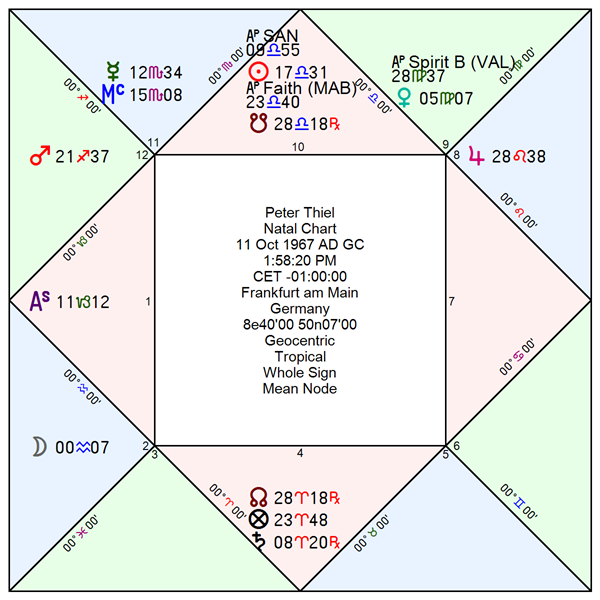
No Astrodatabank Record
Proposed Rectification: 1:59:19 PM, ASC 11CP12’51”
Permission: I grant the unlimited use of this rectified horoscope by the public. Credit ‘Regulus Astrology LLC’ and include an accompanying link to this webpage.
The analytical models used in the sections below are part of a larger research program developed across longer white papers and case studies, where the historical sources, rules, and testing methodology are laid out in full. These database entries show the models in practice; readers who want the theoretical foundations can start with the background papers below:
Rectification Hub (I wrote the book on it!)
Soul Hub (white paper, Victor model statistical tests, Moon’s Configuration studies)
Physiognomy Hub (white paper, examples)
Victor Model Factors favoring Mercury/Scorpio
Sign ruler: Lot of Spirit
Bound ruler: Moon, Midneaven, Prenatal Syzygy
Position: conjunct MC within 3 degrees; sextile to ASC within 2 degrees
Mercury/Scorpio is identified as Victor based on sign/bound rulership + position cited above; confirmed by Mercury Firdaria activations which have defined career highlights to date. Mercury is situated in the eleventh whole-sign house of Good Spirit, closely associated with friends, patrons, benefactors, and gains arising from professional associations, while its proximity to the tenth-house cusp by quadrant houses brings Mercurial activities directly into the sphere of career and public authority. Mercury’s placement in Scorpio emphasizes investigation, secrecy, strategic calculation, financial intelligence, the discovery of concealed information, and the sustained pursuit of adversaries. These characteristics are reflected in Thiel’s derivatives trading, PayPal’s fraud-detection systems, Palantir’s intelligence-analysis software, his private investment strategies, and the financing of litigation against Gawker. By whole-sign houses, Mercury rules the sixth house, Gemini, and ninth house, Virgo; by quadrant houses, it also rules the fifth house. The sixth connects Mercury to technical work, operational systems, and the organization of specialized labor, while the ninth encompasses Thiel’s philosophical and ideological commitments, his criticism of universities, and his efforts to establish alternative educational institutions. The additional fifth-house rulership connects Mercury to financial speculation, entrepreneurial risk-taking, and investment in emerging businesses. Mercury also disposes the Lot of Spirit in Virgo, reinforcing its significance for Thiel’s professional direction. The Moon in Aquarius, occupying Mercury’s Egyptian bound, adds a Mercurial imprint to the Moon’s Firdaria period of 1998–2007, during which Thiel established the principal foundations of his technology fortune through PayPal, Palantir, Facebook, and Founders Fund. Mercury thus connects the accumulation of wealth through technological networks with the investigative methods, financial strategies, ideological commitments, and influential relationships through which Thiel has exercised authority throughout his career.
Physiognomy Model Factors favoring Capricorn, Aries, Virgo
Rising sign: Capricorn
Ruler of rising sign: Saturn/Aries – retrograde
Rising decan: Taurus
Ruler of rising decan: Venus/Virgo
Peter Thiel has a medium build, with a relatively long neck, narrow shoulders, and a lean, moderately elongated face. His facial shape is mixed, neither distinctly oval, rectangular, nor triangular, making it difficult to classify under Willner’s physiognomy model. The forehead is broad and moderately high, with a relatively straight hairline and short, fine brown hair. His eyes are light blue-gray, moderately large, and widely spaced, beneath lightly arched eyebrows. The nose is straight, narrow, and proportionate to the face, while the mouth is moderately wide, with thin lips that appear almost horizontal when he is not smiling. The chin is reasonably prominent without being particularly broad or pointed, and the ears are large and protrude noticeably from the sides of the head. The skin is relatively smooth, with few pronounced wrinkles, contributing to a youthful, almost boyish appearance even in later photographs. Overall, the facial features are regular but rather plain, without any single characteristic dominating the countenance.
Capricorn rising produces a partial but recognizable correspondence with Willner’s physiognomy model. In particular, Willner associates Capricorn with large, protruding ears and a prominent chin, both clearly evident in Thiel’s photographs. However, the face lacks the characteristic ovate shape that completes Willner’s Capricorn type, making the correspondence incomplete rather than definitive. Capricorn’s ruler, Saturn/Aries retrograde, positioned just after acronychal rising and therefore functioning much like direct Saturn/Aries, contributes the straight, thin lips visible when Thiel is not smiling, a characteristic associated with Aries. The Taurus rising decan might suggest a more substantial nose and fuller lips, neither of which is particularly evident. However, the decan ruler, Venus/Virgo, provides a stronger correspondence through the relative absence of wrinkles, youthful facial appearance, and plain, understated features. Venus in its fall in Virgo does not produce the fullness or visual appeal conventionally associated with a well-placed Venus; instead, the features are comparatively unadorned and might be regarded as benefiting from a makeover. In this respect, Thiel shares a physiognomic significator with John D. Rockefeller, whose Venus/Virgo likewise corresponded to a notably plain facial appearance. The combined influence of Capricorn, Saturn/Aries, and Venus/Virgo thus accounts for individual features more convincingly than any single planetary type explains the overall facial shape.
Moon’s Configuration
Stage 1. Moon Separating from Sun (Libra, 9th/10th)
Delineation. The Moon/Capricorn in the first whole-sign house separates from the square of the Sun at 17°31′ Libra, located in the ninth house by quadrant division and the tenth by whole signs. The Sun occupies Jupiter’s bound, connecting its authority to Jupiter/Leo and emphasizing ideological leadership, established social hierarchies, traditional values, and recognized doctrines. The Moon/Capricorn, ruled by Saturn/Aries retrograde, introduces a critical attitude toward existing authority, while the square signifies conflict with the prevailing intellectual and political order. The Sun’s ninth quadrant-house position emphasizes philosophy, religion, and higher education, while its tenth whole-sign position gives these conflicts public significance. The configuration suggests an individual who challenges established authority to replace prevailing doctrines with a competing conception of legitimate social order.
Biographical Match. Thiel’s early public activities centered on opposition to Stanford University’s multicultural curriculum reforms, which he regarded as a rejection of Western civilization’s intellectual foundations. He founded The Stanford Review in June 1987 and published The Diversity Myth with David Sacks in 1995, criticizing affirmative action, academic conformity, and changes to the traditional humanities curriculum. His appearance on William F. Buckley Jr.’s Firing Line on 5 December 1995, timed in the rectified horoscope by a Sun–Midheaven solar arc direction, illustrates the connection between ideological conflict and public recognition. Although Thiel subsequently embraced libertarian politics, his advocacy of dominant technology companies, influential founders, and alternative systems of authority demonstrates that opposition to existing hierarchies did not necessarily imply opposition to hierarchy itself.
Stage 2. Moon at the Moment of Birth (Aquarius, 1st/2nd)
Delineation. At birth, the Moon has crossed from Capricorn into Aquarius, reaching 0°07′ Aquarius in the first quadrant house and second whole-sign house. The separating square to the Sun remains operative at an orb of 12°36′, within William Lilly’s combined Moon–Sun moiety of 13°45′. The change of signs is significant: whereas Moon/Capricorn emphasizes personal ambition and confrontation with established hierarchies, Moon/Aquarius redirects these concerns toward technology, networks, and unconventional systems of economic organization. The Moon’s first quadrant-house position emphasizes personal agency, while its second whole-sign position connects technological activities to wealth accumulation. Saturn/Aries remains the Moon’s dispositor, preserving an underlying antagonism toward conventional institutions.
Biographical Match. Thiel’s career progressed from intellectual criticism of university institutions to financing technology businesses that challenged established arrangements for commerce and information management. PayPal developed an electronic payments network, Facebook demonstrated the economic potential of digitally connected communities, and Palantir created systems for integrating and analyzing information. These investments generated substantial personal wealth, consistent with Moon/Aquarius in the second whole-sign house. The continuing separating square to the Sun connects these ventures to Thiel’s earlier ideological concerns, while the Moon’s first quadrant-house position emphasizes his personal role in organizing and financing technological alternatives.
Stage 3. Moon Applying to Saturn (Aries, retrograde, 3rd/4th house)
Delineation. From 0°07′ Aquarius, the Moon applies to the sextile of Saturn at 8°20′ Aries retrograde, situated in the third whole-sign house and fourth quadrant house. Unlike the separating square to the Sun, which occurred in Capricorn, this application takes place in Aquarius, making technological systems the means through which Saturnian objectives are pursued. Saturn, ruler of both signs, is in its fall in Aries, retrograde and positioned just after acronychal rising, giving it much of the character of Saturn/Aries despite its retrograde motion. Saturn normally signifies administrative order, institutional discipline, and centralized authority, but in Aries these functions operate ineffectively or encounter resistance. The sextile presents opportunities for institutional reorganization, although Saturn’s debility suggests that such initiatives may undermine established controls rather than produce durable improvements.
Biographical Match. Thiel’s libertarian philosophy expresses skepticism toward established governmental institutions, favoring privately organized initiatives over conventional public administration. This tendency is particularly evident in Palantir, whose software is increasingly employed in military, intelligence, and civilian government operations. By supplying technologies intended to replace or consolidate existing administrative systems, Palantir participates in restructuring how government agencies collect information and exercise authority. Critics question the resulting concentration of public functions within private technology companies, while supporters emphasize improvements in governmental efficiency. In this configuration, Moon/Aquarius supplies the technological means, while Saturn/Aries signifies the difficulty of exercising institutional authority through conventional command-and-control structures. The application describes Thiel’s movement from challenging established institutions intellectually toward financing systems that may weaken or fundamentally reorganize their traditional mechanisms of control.
Influence of Sect
Thiel’s horoscope is diurnal, placing Saturn and Jupiter in sect, while Venus and Mars are out of sect. Saturn/Aries retrograde, the in-sect malefic, broadens the scope of Thiel’s mission to erode established governmental command-and-control structures. Although Saturn is debilitated in Aries, its sect status strengthens its capacity to pursue this objective through sustained institutional challenges and the development of alternative systems of authority. Jupiter/Leo, the in-sect benefic, reinforces the traditional association between ruling states and religious or ideological belief systems, consistent with Thiel’s interest in powerful leaders, hierarchical organizations, and entrepreneurial ventures functioning as vehicles for secular doctrine. Venus/Virgo, the out-of-sect benefic and in its fall, signifies departures from conventional social expectations, potentially encompassing Thiel’s openly gay personal life and an unconventional or understated artistic sensibility. His sexual orientation is not inherently a manifestation of Venusian debility; rather, the astrological correspondence concerns his relationship to prevailing social conventions. Mars/Sagittarius, the out-of-sect malefic, introduces a more combative and potentially destructive tendency, expressed through ideological confrontation, public expressions of anger, and aggressive litigation. Thiel’s secret financing of lawsuits against Gawker Media, ultimately contributing to the publisher’s bankruptcy, exemplifies the willingness to employ sustained legal conflict against perceived adversaries. Together, the sect distinctions emphasize the contrast between his long-term efforts to restructure institutional authority and the confrontational methods sometimes employed to achieve those objectives.
Complete biographical chronology, rectification and time lord studies available in Excel format as a paid subscriber benefit. File is behind the paywall.