

This Rebecca West post is something of a pop-up addition to the current series, prompted initially by her relationship with H. G. Wells, whose horoscope was posted on Wednesday. West was Wells’s lover for roughly a decade and the mother of his son Anthony, but she was much more than a supporting character in Wells’s biography. By the time of her death in 1983, she could reasonably be described as Britain’s foremost woman of letters, after a career spanning more than seventy years as novelist, critic, journalist, political commentator, and historian of ideas. The public recognition eventually matched the reputation: in 1959 she was invested as a Dame Commander of the Order of the British Empire for her contributions as a writer and literary critic.
There is also an astrological reason for moving directly from Wells to West. This week I have been studying horoscopes in which the Moon separates from Jupiter and applies to Mars, looking for recurring biographical patterns in that sequence. West provides a particularly interesting example. Her Moon separates from Jupiter in Aries and applies to Mars in Pisces, with Mars additionally ruling Jupiter. Jupiter/Aries pushes forward—building, expanding, attacking, or acting from conviction without always considering the second-order consequences—while Mars/Pisces can take conflict into the territory of sacrifice, martyrdom, and the willingness to suffer or die for a belief. Much of West’s mature writing asks what happens when political conviction moves from confident action toward sacrifice and destruction.
Finally, West provides an unexpected link back to an earlier subject in the Jupiter/Leo series: St. Augustine. West published her own study of Augustine in 1933, using him to investigate how one man’s conflicts over sexuality, guilt, sin, and the divided will became embedded in the moral structure of Western civilization. Those questions did not end with Augustine. They expanded into Black Lamb and Grey Falcon, where sacrifice, martyrdom, nationalism, war, and the survival of civilization became central concerns, and later into her reporting on Nuremberg and her writings on treason. What began as a pop-up prompted by H. G. Wells therefore leads into one of the more useful horoscopes for examining the themes running through several recent posts.

Rebecca West was born Cicily Isabel Fairfield on 21 December 1892 in London, the youngest of three daughters of Charles Fairfield, a journalist, and Isabella Mackenzie Fairfield, a pianist. Her childhood was marked by financial instability and the breakdown of her parents’ marriage. In 1901 her father left the family for Sierra Leone in an unsuccessful attempt to establish a pharmaceutical business; after returning to Britain he did not rejoin them and died in 1906. Her mother moved with the daughters to Edinburgh and supported them by teaching music.
As a teenager Fairfield was attracted to both the theater and radical politics. She studied acting in London and adopted the name Rebecca West from the independent-minded heroine of Henrik Ibsen’s Rosmersholm, eventually using it as her permanent professional identity. She became involved with Fabian socialism, feminism and the suffrage movement and began writing for The Freewoman and other radical publications. Her early journalism established the combination that would characterize much of her career: literary criticism joined to political and social argument.
In 1912 West published a hostile review of H. G. Wells’s novel Marriage, attracting the attention of the already established novelist, who was twenty-six years her senior and married. The resulting relationship lasted for roughly a decade and produced their son Anthony West, born in August 1914. Motherhood outside marriage imposed practical and social difficulties on West, but she continued writing and gradually established an independent reputation. Her first novel, The Return of the Soldier (1918), examined the psychological effects of the First World War through the story of a shell-shocked soldier suffering from amnesia.
During the 1920s West expanded beyond fiction into literary criticism, journalism and public lecturing. Her first visit to the United States in October 1923 was particularly important: she was received as a celebrity, undertook a lecture tour and began developing the American readership and professional connections that would remain important throughout her career. Her books during these years included The Judge (1922), The Strange Necessity (1928) and Harriet Hume (1929). By the end of the decade she was no longer primarily known as the young feminist associated with Wells but as an established writer with a transatlantic career.
In 1930 West married Henry Maxwell Andrews, a banker whose financial security allowed her greater freedom to travel and undertake extended projects. The political situation in Germany reinforced an anti-totalitarian tendency that had already emerged in West’s early rejection of Bolshevism. Her short study St. Augustine appeared in 1933. Rather than writing a conventional saint’s life, West examined Augustine’s influence on Western attitudes toward guilt, sexuality, original sin, the divided will and the relationship between spiritual and earthly life. Augustine’s recognition that human beings frequently act irrationally and against their own interests helped move West away from the rational optimism associated with her youthful Fabianism.
That concern with irrationality and self-destruction reached a larger historical scale in Black Lamb and Grey Falcon (1941), the product of West’s travels through Yugoslavia between 1936 and 1938 and approximately five years of work. Combining travel writing, history, politics, autobiography, religion and psychology, the book examined the continuing power of historical memory and the attraction of individuals and nations to sacrifice, martyrdom and defeat. Written against the background of fascism, appeasement and approaching war, it became the central work of West’s mature career and established her not merely as a novelist and critic but as an interpreter of European history and politics.
The Second World War and its aftermath pushed West increasingly toward questions of political loyalty and individual responsibility. She opposed Nazism and supported the Allied war effort, while she and Andrews assisted German refugees. After the war she attended the Nuremberg trials, producing an extended examination of the defendants and the German society from which Nazism had emerged. Her Nuremberg reportage was eventually revised as “Greenhouse with Cyclamens” and collected in A Train of Powder (1955). The underlying question remained one that had occupied her since St. Augustine: how intelligent and apparently civilized people could subordinate moral judgment to systems organized around destruction.
A parallel investigation developed from West’s attendance at British treason trials, particularly that of William Joyce, the Nazi propagandist known as “Lord Haw-Haw.” These cases produced The Meaning of Treason (1947), which examined betrayal not simply as a legal offense but as a psychological and political phenomenon. During the Cold War she increasingly concentrated on Soviet espionage and Communist influence, eventually expanding the book as The New Meaning of Treason (1964). Although West had voted Labour in 1945 and continued to regard herself as belonging to the liberal left, her strong anti-Communism brought her into conflict with many former political allies and led her during the 1950s to defend the legitimacy of investigating Communist infiltration while criticizing aspects of Senator Joseph McCarthy’s conduct.
West nevertheless continued writing fiction. The Fountain Overflows (1956) returned to the material of her childhood through the fictional Aubrey family and became one of her better-known novels. Public recognition followed her established professional standing: she was appointed Dame Commander of the Order of the British Empire in the 1959 New Year Honours. Her later fiction included The Birds Fall Down (1966), a novel of Russian revolutionaries, espionage and political betrayal that brought themes from her political journalism into fictional form.
Henry Andrews died in 1968, leaving West a widow after nearly four decades of marriage. Her relationship with Anthony West remained much more troubled. Anthony became a writer himself, and their disagreements extended to his depiction of his parents and childhood; Rebecca regarded aspects of his autobiographical writing as an attack upon both herself and Wells. The conflict became one of the most difficult personal relationships of her later life. Her sensitivity to betrayal in private relationships paralleled, at least psychologically, the increasingly prominent place occupied by loyalty and treason in her political writing.
West remained publicly active into old age. During the 1970s and early 1980s, republication of her earlier writings and renewed feminist interest brought another period of attention to her work. Rebecca West: A Celebration, a large selection from six decades of writing, appeared in 1977, while early works were subsequently reissued and reassessed. Critics increasingly confronted the difficulty of placing her within a single category: she had been a feminist polemicist, novelist, literary critic, travel writer, political reporter and historian of ideas, often moving between several of these forms within the same work.
Rebecca West died in London on 15 March 1983, aged ninety. Her career had extended for more than seventy years, from the feminist journalism of the Edwardian period through two world wars and into the final decades of the Cold War. Across those years her political position changed substantially—from Fabian socialism and feminist radicalism toward a strongly anti-Communist liberalism—but several questions remained consistent: the tension between reason and irrationality, the individual’s responsibility to resist destructive collective movements, the psychological attraction of sacrifice and betrayal, and the role of imagination in sustaining civilization. Those themes link the apparently disparate stages of her career, from St. Augustine through Black Lamb and Grey Falcon and the Nuremberg reportage to her later writings on treason.
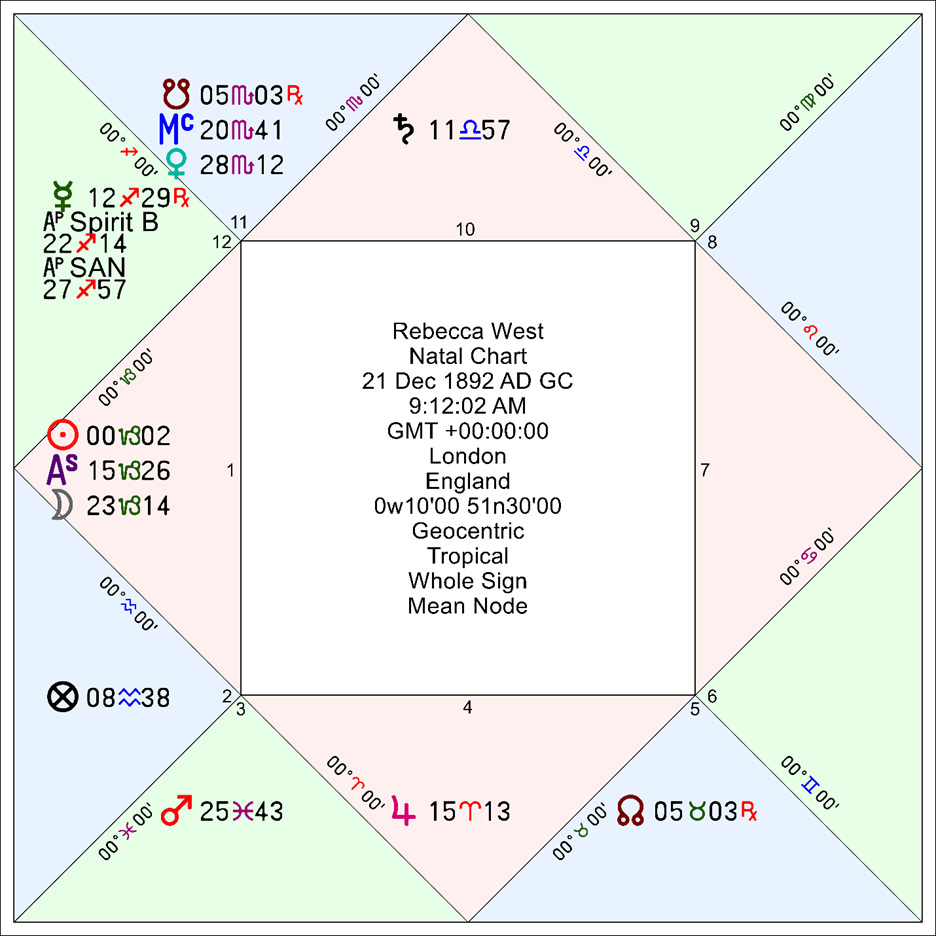
Rodden Rating A, from memory, 8:15 AM, ASC 22SA10 (Edinburgh which is incorrect)
Proposed Rectification: 9:12:02 AM, ASC 15CP26’30”
The analytical models used in the sections below are part of a larger research program developed across longer white papers and case studies, where the historical sources, rules, and testing methodology are laid out in full. These database entries show the models in practice; readers who want the theoretical foundations can start with the background papers below:
Rectification Hub (I wrote the book on it!)
Soul Hub (white paper, Victor model statistical tests, Moon’s Configuration studies)
Physiognomy Hub (white paper, examples)
Victor Model Factors favoring Saturn/Libra
Sign rulership: Ascendant, Sun, Moon, Lot of Fortune
Bound rulership: Moon, Lot of Spirit
Saturn in Libra in the 10th house is the victor of Rebecca West’s horoscope, placing an exalted Saturn in the house of career, reputation, authority, and public standing. Its influence is evident in the gradual construction of a career based not merely on literary talent but on intellectual seriousness, sustained work, historical judgment, and increasing public authority. West can be characterized as a political and civilizational moralist, repeatedly asking what individuals owe to society and by what standards their actions, governments, and political systems should be judged. The Saturn major Firdaria (1932–1943) encompassed St. Augustine (1933), her Yugoslav journeys and years of research and writing, and culminated in Black Lamb and Grey Falcon (1941), the work that established the mature form of her reputation as an interpreter of history, politics, religion, and civilization. Saturn’s minor Firdaria periods likewise repeatedly coincided with consequential professional work and public recognition, including the period surrounding A Train of Powder (1955) and later phases of renewed critical and media attention. Saturn’s exaltation in Libra is particularly appropriate to her recurring concerns with judgment, justice, political responsibility, treason, and the obligations that sustain civilized society; positioned in the 10th, these Saturnian-Libran subjects became the basis of her public vocation and enduring reputation.
Physigonomy Model Factors favoring Libra
Rising sign: Capricorn
Ruler of rising sign: Saturn/Libra
Planets in rising sign: Sun/Capricorn, Moon/Capricorn
Rising decan: Taurus
Ruler of rising decan: Venus/Scorpio


Rebecca West (top). Coco Chanel (bottom).
Rebecca West had a compact, well-proportioned face, broadest across the upper cheeks and tapering toward a relatively narrow, rounded chin. A broad forehead and prominent cheekbones dominated the facial structure, with the sides drawing noticeably inward beneath the cheekbones before narrowing toward the jaw. Her nose was straight and moderately narrow, the mouth full and firm, and the eyes well spaced beneath gently arched brows. Contemporaries repeatedly noticed her dark coloring and expressive eyes: H. G. Wells remembered her “dark, expressive troubled eyes” and “big, soft mouth,” while Virginia Woolf, less charitably, described her as “a cross between a charwoman and a Gypsy.” A 1947 Time profile again singled out her dark brown eyes, observing that her appearance became more striking when intellectual argument animated her expression. These descriptions reinforce what is visible in photographs: a face whose character came from the combination of prominent bone structure, dark features, and unusually expressive eyes.
Astrologically, the physiognomical significator is Libra, matching the compressed ovate in John Willner’s model. The high cheekbones modify the basic ovate form by projecting outward and then cutting inward beneath the cheek, giving the sides of the face their characteristic “notched” appearance. West also has Capricorn rising with Taurus as the rising decan, precisely the same rising-sign and rising-decan combination found in Coco Chanel, whose facial structure bears a noticeable resemblance to West’s despite different rulers governing their respective Ascendants and rising decans. Colette famously characterized Chanel’s appearance as a “black bull,” an image that combines the dark coloring with the heavier bone structure suggested by Capricorn and Taurus; contemporary descriptions of West likewise repeatedly emphasize darkness, solidity, and intensity. Both women show the compressed facial proportions, prominent cheekbones, narrowed lower face, and firmly modeled structure expected from this combination, while West’s Libra significator supplies the underlying compressed-ovate form.
Moon’s Configuration
Stage 1 — Moon separates from Jupiter (Aries, 3rd/4th)
Delineation. The Moon at 23°14′ Capricorn separates from the square of Jupiter at 15°13′ Aries, carrying forward an expansive, confident and aggressively assertive principle. Jupiter/Aries favors initiative, conquest and construction: it advances because it believes something can and should be done, but can bulldoze ahead without adequately considering second-order consequences. Jupiter occupies the 3rd house by quadrant division and the 4th by whole signs, directing this symbolism toward writing and political argument as well as nations, homelands, historical inheritance and the construction or destruction of political orders. Crucially, Jupiter is ruled by Mars in Pisces, the same planet toward which the Moon is moving. The consequences represented by Mars are therefore already implicit in the Jupiterian starting point: expansive or ideological action contains within itself the potential for the sacrifice and destruction eventually revealed by its ruler.
Biographical Match. West repeatedly examined what happens after individuals, movements and nations act with confidence in their own righteousness. Her youthful Fabianism participated in an optimistic belief that society could be deliberately reconstructed, while her early rejection of Bolshevism introduced the problem that would increasingly occupy her: ambitious political projects can produce consequences very different from their stated ideals. St. Augustine examined how one man’s intellectual and theological construction became embedded in Western civilization with consequences extending far beyond its creator’s intentions, while Black Lamb and Grey Falcon enlarged the problem to empires, nationalism, war and political movements. West increasingly judged political action not by the ideals proclaimed at its beginning but by what it built, destroyed and ultimately required human beings to sacrifice.
Stage 2 — Moon in Capricorn near the Ascendant
Delineation. The Moon in Capricorn provides the intermediary principle through which the configuration develops, while its proximity to the Ascendant makes the lunar function unusually prominent in the life and personality. Capricorn subjects Jupiter/Aries action to time, consequence and historical judgment: what was built, what survived, who paid for it, and what obligations followed from it. A Moon near the rising degree can also signify a prophetic capacity, not necessarily as literal prediction but as sensitivity to developing collective conditions and an ability to perceive where present tendencies are leading. The same rising Moon can increase physical receptivity and changeability, making illness or periods of bodily vulnerability more consequential in shaping the life. Positioned between Jupiter/Aries and Mars/Pisces, the Capricorn Moon observes action historically and anticipates where its underlying logic is likely to lead.
Biographical Match. This combination describes West’s mature role as a political and civilizational moralist with a recurrent prophetic dimension. She distrusted Bolshevism earlier than many intellectuals on the left, recognized the danger of appeasement before World War II, and used her Yugoslav travels to examine nationalist and historical forces shortly before the country was invaded and dismembered. Black Lamb and Grey Falcon is particularly characteristic of this rising Capricorn Moon because West continually uses the accumulated past to diagnose the political present and consider its probable consequences. Her later work on Nuremberg, treason and Soviet espionage continued the same procedure: beneath immediate political events she sought longer historical and psychological patterns capable of revealing where those events were leading. Periodic illness and later problems with her eyesight provide the secondary bodily expression traditionally associated with a prominent rising Moon.
Stage 3 — Moon applies to Mars (Pisces, 3rd/4th)
Delineation. The Moon next applies to Mars at 25°43′ Pisces, bringing the configuration toward sacrifice in the service of belief. Mars/Pisces can fight for something larger than individual self-preservation and therefore ranges from courage and voluntary self-sacrifice to martyrdom, fanaticism and the willingness to destroy oneself or others for a transcendent cause. Its danger lies in making suffering itself evidence of moral righteousness, so that defeat, death or sacrifice acquires greater value than survival and practical success. Because Mars also rules the Jupiter from which the Moon has separated, the application completes the logic of the configuration: Jupiter/Aries initiates confident expansion or ideological action, but its ruler reveals the ultimate price embedded within that action. In the 2nd quadrant house Mars concerns what people value enough to sacrifice for; in the 3rd whole-sign house those values become doctrines, political ideas and beliefs capable of mobilizing people toward conflict.
Biographical Match. Mars/Pisces reaches the center of West’s mature thought in Black Lamb and Grey Falcon. The black lamb is a sacrificial victim, while the grey falcon invokes the Kosovo tradition in which Prince Lazar chooses the heavenly kingdom, martyrdom and historical defeat rather than earthly victory. West could recognize the moral grandeur of sacrifice while remaining deeply suspicious of the tendency to make suffering, defeat and death virtuous in themselves. The same problem appears in her criticism of appeasement: refusing to resist aggression might preserve an appearance of moral purity while merely transferring greater suffering to others. From Augustine’s renunciation through Serbian martyrdom, fascism, Nuremberg and political treason, West repeatedly returned to the question implied by the entire configuration: how does confident belief become action, how does action generate consequences, and at what point does devotion to an ideal begin demanding the sacrifice of human life to the ideal itself?
Influence of Sect
The horoscope is diurnal, placing Jupiter and Saturn in sect while Venus and Mars are out of sect, a division that sharpens several of its principal themes. Saturn in Libra, already exalted and identified as the victor, benefits further from sect, supporting the constructive Saturnian qualities of discipline, historical judgment, responsibility, and the public authority of a political and civilizational moralist. Jupiter in Aries is likewise strengthened by sect, allowing its confidence and willingness to engage large political questions to operate more constructively despite its tendency to advance without sufficient consideration of second-order consequences. The out-of-sect Mars in Pisces, destination of the Moon’s configuration, is less controlled, intensifying the more difficult possibilities of sacrifice, martyrdom, ideological violence, and the willingness to subordinate human life to belief.
Venus in Scorpio is also out of sect and therefore less able to deliver its benefic significations conventionally: using the party-in-power analogy, Venus belongs to the party out of power, and love and sexuality readily operate outside prevailing social arrangements, conspicuously expressed by West’s long relationship with the married H. G. Wells and the birth of their son outside marriage. This becomes especially important because Venus rules Saturn, the victor. The in-sect Saturnian moralist therefore ultimately answers to an out-of-sect Venus whose experience lies partly outside established sexual and social conventions. West’s public concern with morality, law, responsibility, and the rules sustaining civilization was consequently not simply the morality of an insider defending conventional standards; the ruler of her victor gave her personal experience of the tension between social law and individual desire, a tension she later examined intellectually in St. Augustine, where sexuality, guilt, and sin became a means of investigating how Western civilization constructed its moral rules.
Early/Late Bloomer Thesis
Rebecca West provides a strong match for the early-bloomer thesis. She was born after a New Moon, with the Moon moving ahead of the Sun; although both luminaries are in Capricorn in the working rectification, the Moon lies beyond the approximately 15° Sun’s bond, so the model should operate normally rather than having the Moon effectively absorbed into the solar condition. Her biography fits the prediction well. West entered journalism while still in her teens, adopted the name Rebecca West and attracted attention for her feminist and political writing at nineteen, and had already become a recognizable public intellectual before the First World War; Cambridge’s Orlando accordingly describes her as having “rose to fame early.” Her first novel, The Return of the Soldier, appeared in 1918 when she was twenty-five, confirming that the professional identity was established well before the midpoint of life. West lived from 21 December 1892 to 15 March 1983, a longevity of about 90 years, placing the midpoint at approximately 45 years of age, in 1938. By that midpoint she had already been professionally active for more than twenty-five years and had published fiction, criticism, journalism, and St. Augustine; she was then engaged in the Yugoslav travels and work that would produce Black Lamb and Grey Falcon. Her later career brought greater authority and recognition, but it represents the maturation of a vocation established unusually early rather than a late emergence, making West a good example of the post-New-Moon early-bloomer pattern.
Complete biographical chronology, rectification and time lord studies available in Excel format as a paid subscriber benefit. File is behind the paywall.