

When studying mundane catastrophes, one occasionally wonders what kind of individuals are born beneath the shadow of those events. The default of Credit Anstalt on 11-May-1931 is widely regarded as one of the decisive triggers which transformed a severe economic downturn into the global catastrophe of the Great Depression’s second phase. International credit markets seized, banking systems destabilized, and the crisis spread outward through Europe and the United States with devastating speed. Just over three weeks later, on 6-Jun-1931, Richard Hickock was born in Kansas City, Kansas — the future architect of the Clutter robbery scheme and one-half of the murderous pair immortalized in Truman Capote’s masterful true crime novel In Cold Blood. While mundane astrology cannot reduce individual destiny to world events alone, Hickock’s horoscope nevertheless raises uncomfortable questions about the relationship between collective crisis and personal fate.
Astrologically, Hickock belongs naturally within the ongoing Jupiter/Cancer series, though in a deeply damaged form. Jupiter is exalted in Cancer and conjunct the Lot of Fortune, a placement ordinarily suggestive of prosperity, protection, abundance, and social elevation. More unusually, Jupiter is also placed in its own bound, strengthening its authority and centrality within the horoscope. Yet the promise of Jupiter/Cancer never stabilizes because the planet suffers two major afflictions. First, Jupiter applies to an opposition with Saturn in Capricorn, introducing frustration, denial, pessimism, and the collapse of grand expectations. Second, Jupiter’s ruler — Moon/Aquarius — is placed in the 12th house of prisons, hidden enemies, confinement, and self-undoing. The result is a horoscope where visions of prosperity remain psychologically powerful but become distorted through rumor, criminality, fantasy, and increasingly destructive social environments.
These themes emerge with remarkable literalness in Hickock’s biography. The central event of his life — the Clutter murders — began with a prison rumor concerning a wealthy farmer’s safe supposedly filled with cash. Hickock became obsessed with the idea that sudden wealth lay hidden within the Clutter farm operation, a symbolic expression of Jupiter/Cancer tied to “money from the land.” Yet the safe did not exist. The fantasy collapsed into robbery, kidnapping, and multiple homicide. In this sense, Hickock’s horoscope does not describe a man devoid of Jupiterian aspiration; rather, it describes a figure whose longing for wealth, pleasure, and escape became trapped within increasingly narrow, criminal, and self-destructive channels.
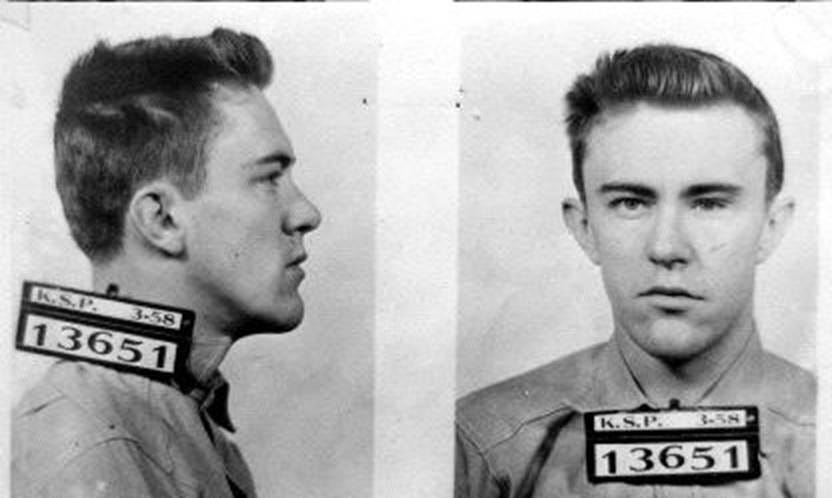
For many Americans, Richard Hickock survives only as one-half of the murderous pair immortalized in In Cold Blood. Yet the enduring fascination with Hickock lies not merely in the horror of the Clutter murders, but in the disturbing ordinariness of the man himself. Unlike Perry Smith — emotionally volatile, physically damaged, introspective, and visibly alienated — Hickock often appeared superficially integrated into postwar American life. He was athletic, socially adept, mechanically skilled, married young, and capable of moving through ordinary Midwestern society without immediately attracting suspicion. That contrast became central to the psychological architecture of Truman Capote’s narrative.
Hickock was born on June 6, 1931, in Kansas City, Kansas, to Walter and Eunice Hickock, a working-class farm family shaped by the discipline and austerity of Depression-era rural America. The family later relocated to Edgerton, Kansas, and Hickock attended high school in nearby Olathe, where classmates remembered him as intelligent, personable, and athletically talented. In another life he might have become a mechanic, salesman, or small businessman. Teachers reportedly considered him college material, though financial limitations prevented higher education. Nothing in his early biography suggested the spectacular violence with which his name would later become associated.
The pivotal event in Hickock’s life occurred in July 1950, when he suffered a catastrophic automobile accident that nearly killed him. The crash left him with severe head injuries and permanent facial asymmetry, most notably the damaged eye later emphasized repeatedly by Capote. Family members and acquaintances would later describe a marked shift in his personality after the accident. Whether this reflected neurological injury, psychological trauma, financial desperation from mounting medical bills, or merely the acceleration of latent tendencies remains uncertain. But in both literary and criminological interpretations, the accident became the dividing line between the earlier socially functional Hickock and the increasingly manipulative, unstable figure that emerged during the 1950s.
Following the accident, Hickock drifted through a succession of jobs — mechanic, railroad laborer, ambulance driver, and factory worker — while his personal life deteriorated. He married young, fathered children, engaged in extramarital affairs, accumulated debt, gambled heavily, and increasingly turned toward petty crime. By the late 1950s he had developed a pattern of theft, fraud, forged checks, and burglary. Unlike Perry Smith, whose instability was emotionally obvious, Hickock’s criminality often retained the appearance of calculated opportunism rather than emotional collapse. He learned to mimic normality while steadily moving outside its boundaries.
In March 1958 Hickock was sentenced to the Kansas State Penitentiary for burglary and theft. There he met Perry Smith and another inmate, Floyd Wells, who claimed that wealthy farmer Herbert Clutter kept a large safe filled with cash inside his farmhouse near Holcomb. The story became the foundation of the Clutter robbery plan. Hickock, more socially confident and operationally organized than Smith, became the driving logistical force behind the crime. He arranged transportation, coordinated the trip, and framed the robbery as a quick path to financial recovery after years of frustration and failure.
On the night of November 14–15, 1959, Hickock and Smith entered the Clutter farmhouse expecting to find thousands of dollars. Instead they found almost nothing. Yet despite the failure of the robbery, the entire Clutter family — Herbert, Bonnie, Nancy, and Kenyon — was bound and murdered. Although Smith carried out the actual shootings, Hickock’s full complicity in the planning, kidnapping, and execution of the crime left little moral distinction between the two men. The murders horrified the nation precisely because they lacked conventional emotional motive. There was no feud, no revenge, no profit sufficient to explain the brutality. The randomness of the violence shattered the postwar myth that rural America remained insulated from modern criminal terror.
Capote’s treatment of Hickock in In Cold Blood remains psychologically revealing. While Capote developed considerable sympathy for Perry Smith — whose traumatic childhood and emotional instability offered tragic literary depth — Hickock is often portrayed as colder, flatter, and more predatory. He becomes the embodiment of shallow charm without conscience: a man capable of social mimicry but detached from moral restraint. Capote repeatedly returned to Hickock’s damaged face and asymmetrical eyes, using physical distortion almost symbolically, as though the automobile accident had externalized a deeper moral fracture already underway.
After their arrest in Las Vegas on December 30, 1959, Hickock and Smith were extradited to Kansas, tried, convicted, and sentenced to death. Hickock spent nearly five years on death row maintaining that Smith alone committed the murders, though later evidence suggested Hickock minimized his own operational role. On April 14, 1965, both men were executed by hanging. Hickock was put to death first shortly after midnight.
The legacy of Richard Hickock remains inseparable from the cultural afterlife created by Truman Capote. Before Capote, the Clutter murders were a shocking but regional crime. After In Cold Blood, they became part of the permanent mythology of American violence. Hickock occupies a particularly unsettling place within that mythology because he did not outwardly resemble a monster. He appeared instead as something more modern and psychologically disquieting: an intelligent, socially functional man whose moral collapse unfolded gradually beneath the ordinary surfaces of postwar American life.
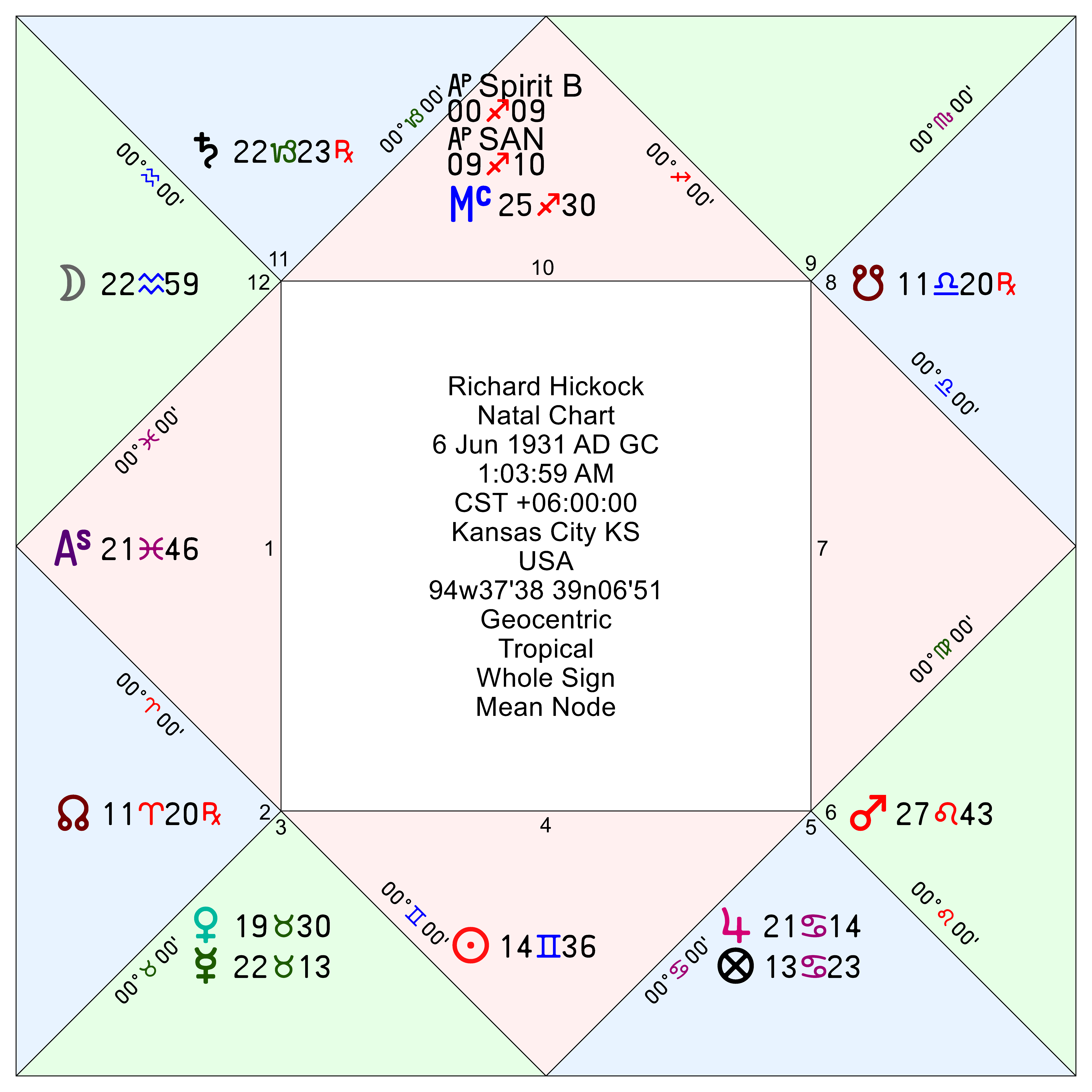
Rodden Rating AA, BC/BR in hand, 1:06 AM, ASC 22PI36
Proposed Rectification: 1:03:59 AM, ASC 21PI46’20”
The analytical models used in the sections below are part of a larger research program developed across longer white papers and case studies, where the historical sources, rules, and testing methodology are laid out in full. These database entries show the models in practice; readers who want the theoretical foundations can start with the background papers below:
Rectification Hub (I wrote the book on it!)
Soul Hub (white paper, Victor model statistical tests, Moon’s Configuration studies)
Physiognomy Hub (white paper, examples)
Victor Model Factors favoring Jupiter/Cancer
Sign ruler: Ascendant, Midheaven, Lot of Spirit, Prenatal Syzygy
Bound ruler: Lot of Spirit, Prenatal Syzygy
Jupiter/Cancer as victor of the horoscope signifies Richard Hickock’s obsessive pursuit of wealth, pleasure, and social elevation through 4th and 5th house themes tied to land, farming, hidden assets, and speculative schemes. Jupiter is exalted in Cancer and conjunct the Lot of Fortune in the 5th house, a placement which becomes especially important when derived houses are considered. The 5th house is 2nd from the 4th — literally “money from the land.” Because the 4th house signifies farmland, property, and the earth itself, Jupiter/Cancer describes Hickock’s fixation on wealth connected to a farmer’s money. In practical terms, this symbolism manifested through his fantasy that wealthy Kansas farmer Herbert Clutter possessed a safe filled with cash generated through farm operations. Hickock imagined the Clutter farm as a hidden reservoir of prosperity capable of transforming his life overnight, a textbook expression of Jupiter/Cancer linked to agricultural wealth, property income, and imagined financial abundance.
Yet the configuration contains two serious afflictions which prevent Jupiter/Cancer from delivering the prosperity Hickock imagines. First, the Moon, ruler of Jupiter/Cancer, is placed in Aquarius in the 12th house and in aversion to Jupiter, meaning the ruler “does not see” the object it governs. The 12th house also signifies prisons, confinement, hidden enemies, and damaging rumors — precisely the environment in which Hickock first learned of the supposed Clutter safe while incarcerated with Floyd Wells at the Kansas State Penitentiary. Thus Moon/Aquarius/12th signifies not merely a false rumor, but a prison rumor: information acquired in confinement which Hickock mistakenly believed would lead to financial salvation. Second, Jupiter applies by opposition to Saturn in Capricorn, a configuration signifying obstruction, denial, and frustration of Jupiter’s promised rewards. Saturn/Capricorn/11th becomes the mechanism through which Hickock’s expectations collapse, with Floyd Wells serving as the intermediary source of the fatal misinformation. The safe did not exist, the robbery yielded almost nothing, and the grand vision of sudden prosperity disintegrated into one of the most infamous murder cases in American history. Thus Jupiter/Cancer remains fully operative psychologically — Hickock never stops believing in wealth, pleasure, sex, gambling, and shortcuts to prosperity — but the combined damage from Moon/12th aversion and Saturnine opposition ensures repeated failure, frustration, and eventual catastrophe.
Physiognomy Model Factors favoring Cancer, Aquarius, Leo
Rising sign: Pisces
Rising sign ruler: Jupiter/Cancer
Rising decan: Scorpio
Rising decan ruler: Mars/Leo
Richard Hickock possessed a striking appearance which helps explain why so many observers later remarked on the disconnect between his outward presentation and the brutality of the Clutter murders. Contemporary descriptions consistently portray him as taller and leaner than Perry Smith, with Hickock standing approximately 5’11” and weighing near 165 pounds during the late 1950s. His build was narrow, wiry, and athletic rather than physically imposing. The face itself combined contradictory features: youthful softness paired with sharp angularity. In the well-known portrait photograph, Hickock’s face retains a smooth, almost adolescent quality despite adulthood, producing the unsettling impression of a “boyish” criminal later emphasized by Truman Capote. The eyes are slightly asymmetrical from the 1950 automobile accident, yet the overall expression remains calm, alert, and socially composed rather than overtly menacing. Particularly notable are the rounded eyebrows, smooth cheeks, broad upper cranium, and highly structured forehead which forms a flat, rectangular plane above the eyes. The pompadour hairstyle intensifies the vertical height of the skull and gives the head a streamlined, aerodynamic appearance, especially in side profile. Altogether the combination creates a face that appears intelligent, emotionally restrained, and superficially trustworthy, while simultaneously conveying a subtle emotional coldness beneath the polished exterior.
Astrologically, Hickock’s physiognomy reflects a layered combination of three separate significators. The dominant influence is Jupiter/Cancer, ruler of the Pisces Ascendant and placed in a partile trine to the Ascendant degree. This Cancer influence contributes the underlying “baby face” typology visible in the softness of the cheeks, rounded eyebrows, smooth skin texture, and the almost lunar quality of the face seen most clearly in the non-mugshot portrait. The effect resembles the old folkloric “man in the moon” appearance frequently associated with strong Cancer symbolism. Yet Jupiter’s ruler, Moon/Aquarius, modifies this softness by imposing a distinctly Aquarian geometric structure upon the forehead. The broad rectangular forehead resembles a bulldozer blade: flat, vertical, mechanical, and highly pronounced above the eyes. This Moon/Aquarius influence introduces intellectual coldness and abstraction into what would otherwise be a softer Cancerian physiognomy. Finally, Mars/Leo, ruler of the rising decan, contributes the smallest but most visually dramatic feature: the pompadour hairstyle itself. The hair rises sharply upward from the scalp in a radiating formation suggestive of solar rays, a classic Leonine image modified through Martian sharpness and heat. Rather than producing the full rounded leonine mane described in traditional physiognomy texts, Mars/Leo here sharpens and streamlines the appearance into a more angular, arrowhead-shaped cranial form.
Moon’s configuration
Phase I. Moon separating from Mercury (Taurus, 3rd House)
Delineation. The Moon at 22AQ59 in the 12th house separates from a trine to Mercury at 22TA13 in the 3rd house. Moon-Mercury combinations signify movement, messages, information, calculation, coordination, and the transmission of facts or rumors. Because the Moon is placed in Aquarius in the 12th house, the information stream is hidden, confined, or damaging. The 12th house signifies prisons, confinement, hidden enemies, and self-undoing; therefore, the Moon’s separation from Mercury can signify information received through a concealed or imprisoned environment. Mercury in Taurus in the 3rd house adds practical cunning, road movement, vehicles, local travel, and the mechanics of planning.
Biographical Match. This phase matches Hickock’s role as the organizer and logistical mind behind the Clutter robbery scheme. The most important “information event” in the biography is the prison rumor that Herbert Clutter kept a safe filled with cash in his farmhouse. Hickock learned this while incarcerated from Floyd Wells, a former Clutter farmhand. The Moon in the 12th describes the prison setting and the false rumor; Mercury in the 3rd describes the transmission of information, planning, road travel, and the practical mechanics of converting that rumor into a robbery plan. The trine shows that Hickock could organize and act on information efficiently, but the 12th-house Moon shows that the information itself was corrupted from the start.
Phase II. Mercury applying to Saturn (Capricorn, 11th House)
Delineation. Mercury at 22TA13 next applies to a trine with Saturn at 22CP23 in the 11th house. Although Saturn is strong in Capricorn, this is a night chart, making Saturn the out-of-sect malefic. This damages Mercury by linking thought, calculation, speech, and planning to Saturnian themes of obstruction, imprisonment, coldness, fear, and eventual punishment. Saturn also rules the 12th house occupied by the Moon, strengthening the connection between Mercury’s information and the prison environment from which the fatal rumor emerged. The 11th house signifies friends, associates, alliances, and accomplices; under Saturn, these alliances become cold, utilitarian, and destructive.
Biographical Match. This phase points directly to Floyd Wells and the prison network that supplied the Clutter rumor. Wells, as Hickock’s cellmate and source of the supposed safe, becomes the 11th-house Saturn figure: an associate whose information appears solid but ultimately obstructs and destroys the hoped-for Jupiterian reward. Mercury applying to Saturn also describes Hickock’s criminal intelligence narrowing into a fixed, fatal plan. The same Mercury that could have signified mechanical skill, practical work, or ordinary mobility becomes bound to Saturn’s world of prison, false alliance, and punishment. Hickock’s cleverness did not free him; it delivered him back into confinement and finally to death row.
Phase III. Moon applying to Mars (Leo, 6th House)
Delineation. After separating from Mercury, the Moon applies to the opposition of Mars at 27LE43 in the 6th house. This is the violent culmination of the configuration. Mars signifies aggression, weapons, danger, coercion, physical risk, and bloodshed. In Leo, Mars becomes heated, proud, dramatic, and forceful; in the 6th house, it is linked to injury, bodily suffering, servitude, hard labor, and affliction. The Moon’s movement from Mercury toward Mars shows a narrative arc in which information, planning, and criminal mobility escalate into violence. The traditional association of Mercury-Mars aspects with highwaymen, robbers, and thieves is especially relevant here because Mercury first receives the Moon’s separation and then stands as part of the larger sequence that leads to Mars.
Biographical Match. Hickock’s life followed this sequence with remarkable literalness. He began as a petty criminal: bad checks, theft, burglary, fraud, gambling, and small-time schemes. The Clutter plan began as Mercury — a rumor, a calculation, a road trip, a practical theft. But the Moon’s application to Mars shows the outcome: the robbery became an armed invasion and then a multiple homicide. Hickock may not have fired the fatal shots, but he was the planner, accomplice, and active participant who carried the Mercury phase into the Mars phase. What might otherwise have remained petty criminality escalated into violence, bloodshed, and irreversible catastrophe.
Influence of Sect
Because Richard Hickock was born in a nocturnal figure, Venus and Mars become the in-sect planets while Jupiter and Saturn are pushed out-of-sect, substantially altering how their symbolism manifests. Venus/Taurus co-present with Mercury in the 3rd house softens Mercury’s criminal cunning with a desire for pleasure, comfort, and socially valued objects. Hickock’s thefts and fantasies of wealth were not oriented toward abstract power or ideological motives, but toward money, attractive possessions, indulgence, mobility, sex, and the appearance of prosperity. Even the Clutter robbery itself centered upon the imagined existence of cash hidden inside a prosperous farm household.
Mars, although naturally malefic, is moderated somewhat by sect. This does not make Mars harmless, but it may restrain impulsive bloodlust and uncontrolled violence. Hickock consistently appeared more calculating and organizational than explosively violent, a point which lends at least partial astrological support to his long-standing claim that Perry Smith fired the fatal shots inside the Clutter farmhouse. Mars in-sect still places Hickock within violence and criminal danger, but more as an active participant, accomplice, planner, or coercive presence than necessarily the uncontrollable killer himself.
By contrast, the out-of-sect planets show where Hickock’s life became increasingly distorted and marginalized. Jupiter/Cancer out-of-sect narrows and corrupts the otherwise expansive promise of Jupiter, reducing it to unrealistic “get-rich-quick” fantasies and exaggerated assumptions about hidden wealth, such as the wildly inaccurate belief that Herb Clutter kept a fortune in cash on hand. Saturn out-of-sect in Capricorn further isolates Hickock socially, binding him to prison culture, damaged alliances, criminal associates, pessimism, and ultimately the destructive friendships that led to the Clutter murders. Together the sect doctrine describes a figure whose search for pleasure, wealth, and social elevation became trapped within increasingly narrow, criminal, and self-destructive social worlds.
Early/Late Bloomer Thesis
Richard Hickock presents a difficult but still instructive case for the early/late bloomer model because his life was cut short by execution at age 33. Hickock was born on 6-Jun-1931 and died on 14-Apr-1965, giving him an actual longevity of 33 years, 10 months, and 8 days. The midpoint of life therefore falls on approximately 10-May-1948. Because Hickock was born shortly after a Full Moon with a waning or preventional Moon, the model would classify him as a late bloomer, meaning the decisive and most consequential developments of life should cluster after the midpoint rather than before it.
The chronology broadly supports this interpretation, though in a highly pathological form. Before the midpoint, Hickock’s life appears comparatively conventional. He grew up in a stable Kansas farm environment, performed reasonably well in school, displayed athletic ability, and maintained the outward appearance of an ordinary postwar Midwestern youth. While there may already have been signs of restlessness or opportunism, there is little evidence prior to age 16–17 that he had fully entered the criminal trajectory which later defined his life. In this sense, the pre-midpoint years appear relatively undeveloped compared to what followed.
After the midpoint in May 1948, however, the defining events of Hickock’s life begin to unfold rapidly. The catastrophic automobile accident of July 1950 — often described by family and observers as a turning point in personality and behavior — occurs only two years after the midpoint. What follows is a cascading sequence of increasingly consequential developments: unstable employment, failed marriages, gambling, forged checks, burglary, imprisonment, criminal networking inside prison, the meeting with Floyd Wells and Perry Smith, formulation of the Clutter robbery plan, the murders themselves in 1959, worldwide notoriety through the Capote case, conviction, death row, and eventual execution. Virtually every event for which Hickock is historically remembered occurred after the midpoint of life.
The case therefore fits the late bloomer model in a dark but structurally coherent manner. Hickock’s earlier years contain potential and relative normality, while the second half of life becomes dramatically more consequential, visible, and fate-driven. Importantly, the model does not require that late blooming produce success, wisdom, or constructive achievement. In Hickock’s case, the “bloom” manifests as the full emergence of the destructive destiny latent within the horoscope. His life became historically significant only after the midpoint, and the acceleration of events after 1948 is striking enough to support the broader thesis that preventional Moon figures often experience their decisive life trajectory later rather than earlier.
Complete biographical chronology, rectification and time lord studies available in Excel format as a paid subscriber benefit. Files are behind the paywall.