

Last week we began this series on Jupiter in Leo with Anton Bruckner, whose music offered one expression of this placement’s concern with belief, moral order, and the enduring ideals of civilization. This week we turn to Richard Wagner, whose Jupiter occupies nearly the same position in Leo as Bruckner’s. Next week we will complete this opening trilogy with Gustav Mahler, allowing three of the nineteenth century’s greatest composers to illustrate how a common planetary placement can produce distinct but related visions of the world.
The purpose of this series is not merely to catalog historical figures with Jupiter in Leo, but to understand the quality of consciousness that accompanies the placement. Jupiter in Leo repeatedly seeks to articulate the guiding creed of a civilization—its moral vision, heroic ideals, and shared understanding of what gives life meaning. Music often provides one of the clearest expressions of this impulse because it communicates emotional and spiritual convictions that lie beyond ordinary language. Listening to Bruckner, Wagner, and Mahler in succession therefore becomes more than an aesthetic exercise; it offers an opportunity to enter the Jupiter-in-Leo mode itself and experience how each composer gave voice to a different aspect of the civilization’s moral imagination.
Wagner provides perhaps the most ambitious example of the three. Rather than composing individual operas alone, he attempted to construct an entire mythological universe governed by its own moral logic, historical destiny, and artistic ideals. The horoscope reflects this expansive vision in several ways, beginning with Jupiter in Leo as the victor of the nativity, strengthened by sect and closely anchored to the foundation of the chart. Yet the same figure also reveals why this vision unfolded amid continual conflict, political exile, financial instability, and criticism from established musical authorities. The tension between an expansive cultural ideal and the struggles required to realize it forms one of the central themes of Wagner’s life and provides the framework for the analysis that follows.
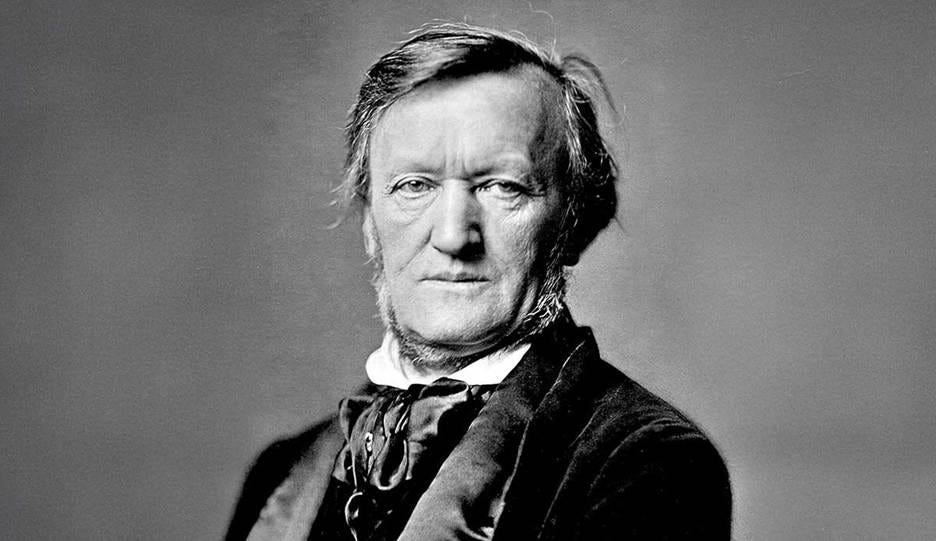
Richard Wagner was a German composer, librettist, conductor, essayist, and theorist whose works reshaped nineteenth-century opera. Seeking to unite music, poetry, drama, and stagecraft into what he called the Gesamtkunstwerk, or “total work of art,” he expanded the expressive possibilities of music drama through works including The Flying Dutchman, Tannhäuser, Lohengrin, Tristan und Isolde, Die Meistersinger von Nürnberg, the four-opera Ring des Nibelungen, and Parsifal. His influence extended to composers such as Anton Bruckner, Gustav Mahler, Richard Strauss, and Claude Debussy.
His career unfolded through alternating periods of artistic success, financial hardship, political exile, and renewed patronage. Frequently pursued by creditors and often dependent upon the assistance of friends and benefactors, Wagner nevertheless continued to pursue increasingly ambitious artistic projects. His ability to recover from professional and personal reversals became a recurring feature of his life.
Born in Leipzig on May 22, 1813, and raised primarily in Dresden, Wagner developed literary interests before turning seriously to music. Shakespeare, Greek tragedy, and German Romantic literature shaped his early imagination, while Beethoven’s symphonies inspired him to combine poetry and music within a single dramatic form. By his late teens he had composed orchestral works and begun writing operas.
Early appointments as a conductor in Würzburg, Magdeburg, Königsberg, and Riga provided practical theatrical experience but little financial stability. His first operas, Die Feen and Das Liebesverbot, failed to establish his reputation, and his marriage to the actress Minna Planer was marked by recurring financial difficulties. Mounting debts forced the couple to flee Riga in 1839, undertaking a hazardous sea voyage that later inspired The Flying Dutchman.
The following years in Paris proved disappointing professionally. Wagner struggled to obtain performances, supported himself through journalism and musical arrangements, and narrowly avoided imprisonment for debt. At the same time he completed Rienzi, conceived The Flying Dutchman, and gradually moved away from the conventions of French grand opera toward the style that characterized his mature works.
His fortunes improved in 1842 when the Dresden premiere of Rienzi established him as one of Germany’s promising operatic composers. Soon afterward he was appointed Royal Kapellmeister in Dresden, where he composed The Flying Dutchman, Tannhäuser, and Lohengrin. These operas increasingly departed from conventional operatic forms through continuous musical structure, recurring thematic ideas, and expanded orchestration.
The revolutions of 1848 altered the course of his life. Wagner openly supported the democratic movement in Dresden and became associated with several leading revolutionaries. Following the failure of the Dresden uprising in May 1849, a warrant was issued for his arrest, forcing him to flee Germany and begin more than a decade of political exile.
Living primarily in Zürich, Wagner devoted himself to composition and theoretical writing. During these years he published Art and Revolution, The Artwork of the Future, and Opera and Drama, while developing the conception that became the four-opera Ring des Nibelungen. Originally planned as a single opera, the project expanded into a cycle tracing the rise and destruction of a mythological world. Exile also brought important personal changes. Wagner’s relationship with Mathilde Wesendonck, together with his growing interest in the philosophy of Arthur Schopenhauer, led him to interrupt work on the Ring in order to compose Tristan und Isolde. Its treatment of harmony and tonal tension influenced later nineteenth-century music and marked an important stage in his artistic development.
Professional difficulties nevertheless continued. The Paris production of Tannhäuser collapsed amid organized disruptions in 1861, while his financial problems became increasingly severe. His circumstances changed in 1864 when the young King Ludwig II of Bavaria invited him to Munich, paid his debts, and provided the financial support needed to continue his work.
Equally important was Wagner’s relationship with Cosima von Bülow, daughter of Franz Liszt and wife of the conductor Hans von Bülow. Following Minna’s death and Cosima’s divorce, they married in 1870. Cosima became Wagner’s closest collaborator and later the principal guardian of his artistic legacy. Their home at Triebschen attracted a circle of musicians, writers, and intellectuals, including the young Friedrich Nietzsche.
The late 1860s and early 1870s marked a productive period. Tristan und Isolde finally reached the stage in 1865, Die Meistersinger von Nürnberg premiered in 1868, and Wagner resumed work on the Ring after an interruption of nearly a decade. Completion of Götterdämmerung in 1874 brought to a close more than twenty-five years of work on the cycle.
Wagner also pursued the creation of a permanent theater devoted to his music dramas. Choosing the Bavarian town of Bayreuth, he supervised construction of the Festspielhaus, whose design reflected his ideas concerning theatrical presentation and acoustics. The first Bayreuth Festival opened in 1876 with the inaugural complete performance of the Ring des Nibelungen, establishing a tradition that has continued into the present.
His final major work, Parsifal, occupied much of his remaining creative energy. Completed in January 1882 and premiered at Bayreuth later that year, it combined Christian symbolism, medieval legend, and philosophical themes that had interested Wagner for decades.
After the first Bayreuth performances of Parsifal, Wagner traveled to Venice seeking rest. On February 13, 1883, he died of a heart attack at the Palazzo Vendramin-Calergi. He was buried in the garden of Wahnfried, his home in Bayreuth.
Wagner remains one of the most influential and controversial figures in the history of Western music. His operas transformed nineteenth-century music drama, while his theoretical writings, political views, and antisemitism continue to be the subject of scholarly debate. His mature works remain central to the operatic repertory, and the Bayreuth Festival continues to preserve the performance tradition he established.
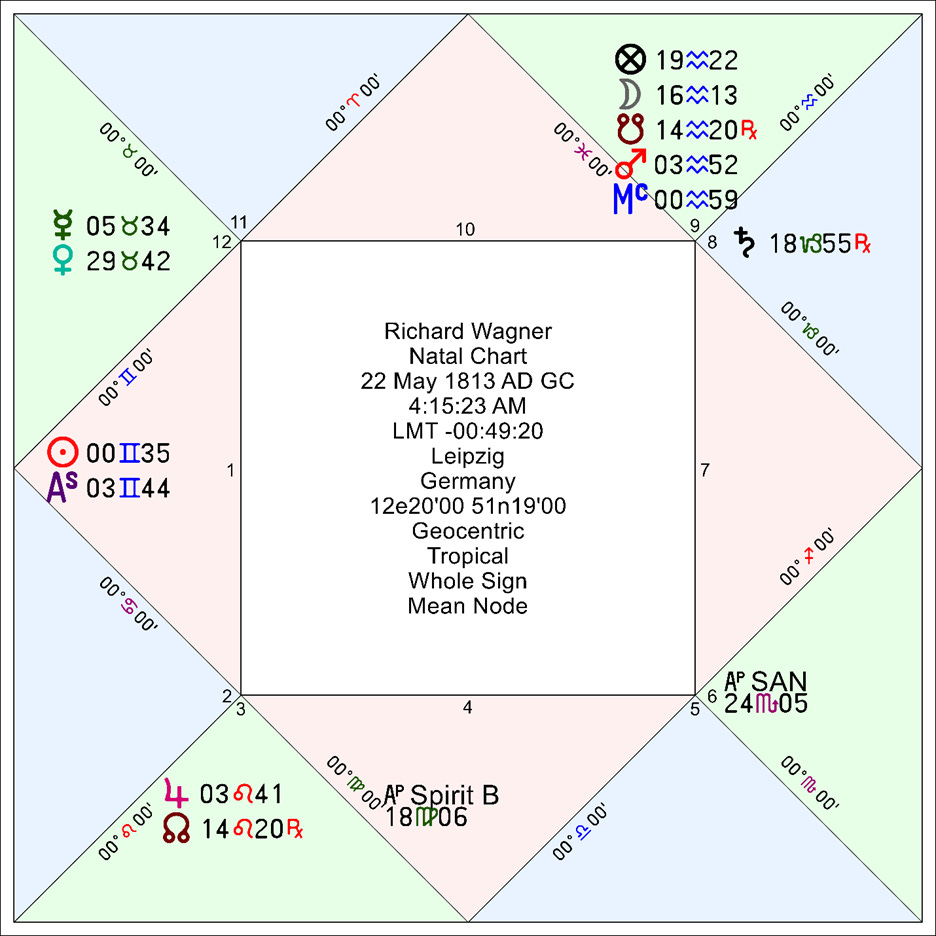
Rodden Rating C, Rectified from approx time. 4:00 AM, ASC 28TA21
Proposed rectification: 4:15:23 AM, ASC 3GE44’39”
The analytical models used in the sections below are part of a larger research program developed across longer white papers and case studies, where the historical sources, rules, and testing methodology are laid out in full. These database entries show the models in practice; readers who want the theoretical foundations can start with the background papers below:
Rectification Hub (I wrote the book on it!)
Soul Hub (white paper, Victor model statistical tests, Moon’s Configuration studies)
Physiognomy Hub (white paper, examples)
Victor Model Factors favoring Jupiter/Leo
Bound ruler: Moon, Lot of Fortune, Lot of Spirit
Jupiter in Leo emerges as the victor of the horoscope, describing a life devoted to the public proclamation of an artistic and philosophical vision. Positioned in the 3rd whole-sign house, Jupiter signifies the communication of ideas through writing, music, and dramatic narrative, while its placement within four degrees of the IC by quadrant houses anchors that vision in the creation of a lasting cultural foundation. Wagner sought not merely to compose operas but to establish an enduring artistic tradition through Bayreuth, a permanent institution intended to preserve his conception of music drama for future generations. Opposing Jupiter is a separating Mars in Aquarius, an aspect that repeatedly placed this constructive vision in conflict with political authorities, financial pressures, public controversy, and personal rivalries. Rather than preventing Jupiter’s aims, these struggles became the means through which his artistic program was defined and ultimately secured, making the tension between cultural creation and open conflict one of the central themes of his life.
Physiognomy Model Factors favoring Taurus
Rising sign and decan: Gemini
Ruler of rising sign and decan: Mercury/Taurus
Planet in rising sign and decan: Sun/Gemini
Richard Wagner possessed a solid, broad-framed build with a comparatively short, thick neck, rounded shoulders, and a substantial upper torso rather than a lean or angular physique. His face is dominated by a broad forehead, full cheeks, a wide jaw, and relatively soft facial contours that retain their fullness well into later life. Even in old age his features appear compact and fleshy rather than gaunt, while his eyes project steady concentration more than restless animation. Contemporary descriptions likewise emphasized his compact stature and stocky build rather than physical height or athleticism, with much of his presence deriving from posture, expression, and intensity rather than imposing size.
From an astrological perspective, Wagner’s appearance corresponds most closely with Taurus, the principal physiognomic significator of the nativity. In John Willner’s physiognomic model, Taurus produces the soft rectangular body and facial structure, characterized by broad proportions, substantial musculature, rounded contours, and a tendency toward fullness rather than angularity. Wagner’s broad face, square jaw, thick neck, and compact, powerful frame conform well to this pattern. Although advancing age introduced additional softness to the features, the underlying Taurean rectangular structure remained clearly visible throughout his life, making Taurus the dominant influence in his outward appearance.
Moon’s Configuration
The Moon technically separates from Mercury and eventually perfects a square to Venus after both Moon and Venus change signs. Yet both Moon-Mercury and Moon-Venus aspects lie outside moiety, rendering the Moon effectively void-of-course at birth. This leaves the Moon’s close conjunction with the South Node as the dominant influence upon its configuration. Rather than being readily redirected by surrounding circumstances, the Moon repeatedly returns to its own perceptions and convictions, producing an inwardly focused emotional life that becomes increasingly self-reinforcing over time.
Placed in Aquarius and the bound of Jupiter, the Moon instinctively gravitates toward large-scale ideals, intellectual systems, and imagined social or artistic orders. Because its bound lord, Jupiter in Leo, is the victor of the nativity, these private convictions continually support a public sense of mission. Wagner’s emotional life therefore did not simply nourish artistic creativity; it reinforced the belief that his own vision represented the proper future of opera, theater, and German culture. The close conjunction with the South Node intensified this tendency, encouraging repeated immersion in a personal ideal that often proved resistant to compromise, criticism, or practical limitation.
Influence of Sect
The nativity is diurnal, placing Jupiter and Saturn in sect while Venus and Mars are contrary to sect. This arrangement favored the realization of Wagner’s larger intellectual ambitions while tempering, rather than preventing, the opposition they encountered. As the victor of the horoscope, Jupiter in Leo, strengthened by sect, enlarged the scope of his artistic imagination and sustained the expansive moral and mythological universe that came to define his mature operas.
Saturn in Capricorn, also in sect, retrograde in the 9th house and ruling the 3rd by quadrant houses, functioned as bad press from established musical and intellectual traditions against which Wagner measured himself - here is the signature for the conflict between traditional harmonies of Brahams and modern innovations by Wagner
By contrast, Venus, contrary to sect, reflects the initial resistance many audiences and critics expressed toward his evolving musical language, whose departures from accepted operatic practice often required years before gaining wider acceptance.
Mars in Aquarius, the out-of-sect malefic, repeatedly disrupted Wagner's public career through the topics of its house rulerships. By whole-sign houses, Mars rules the 11th of alliances, benefactors, and career income, corresponding to the chronic financial instability that accompanied even his greatest artistic successes. Publishers, theaters, patrons, and professional relationships repeatedly failed to provide lasting security, leaving Wagner dependent upon extraordinary interventions such as the patronage of King Ludwig II. Mars also rules the 6th, becoming active during the final period of his life and corresponding with bodily illness culminating in his fatal heart attack. By quadrant houses, Mars rules the 12th, shifting the emphasis toward imprisonment, exile, fear, and flight. Wagner's illegal escape from Riga, his flight following the Dresden uprising, and his repeated efforts to evade creditors all reflect this symbolism. Yet because Mars separates from its opposition to Jupiter, the victor of the nativity, these hardships repeatedly redirected rather than defeated Jupiter's larger artistic mission, making conflict the recurring means through which his enduring achievements were realized.
Early/Late Bloomer Thesis
Richard Wagner lived 69 years, yielding a midpoint of approximately 35 years, which falls in 1848. Up to that point he had certainly established himself as an important composer. He had completed Rienzi, The Flying Dutchman, Tannhäuser, and Lohengrin, had been appointed Royal Kapellmeister at Dresden, and had begun attracting national attention. Yet these accomplishments were followed almost immediately by the Dresden uprising of 1849, political exile, financial insecurity, and the interruption of what might otherwise have been a conventional operatic career. Rather than representing the culmination of his life, the years surrounding the midpoint became a period of disruption that redirected his artistic ambitions toward much larger goals.
The strongest evidence for the late-bloomer model lies in the decades after the midpoint. During exile Wagner conceived and developed the Ring des Nibelungen, composed Tristan und Isolde, completed Die Meistersinger, resumed and finished the Ring after a long interruption, secured the patronage of King Ludwig II, married Cosima, founded the Bayreuth Festival, completed Parsifal, and established the institutional and artistic legacy for which he is principally remembered. Nearly all of the achievements that define Wagner’s historical reputation—including Bayreuth itself—belong to the second half of his life. Although his pre-midpoint years established the technical and artistic foundations of his career, the evidence favors classifying Wagner as a late bloomer, consistent with the expectation for a nativity born during the waning lunar phase after the Full Moon.
Complete biographical chronology, rectification and time lord studies available in Excel format as a paid subscriber benefit. Excel file is behind the paywall.