

The North Node has just entered Aquarius, opening a new chapter for a sign closely associated with computer technology. As a fixed air sign, Aquarius does not simply circulate information; it collects, stores, and organizes it, making the sign a natural fit for databases, computer memory, and the vast quantities of information packed onto computer chips. Sam Altman provides a useful natal example. Jupiter/Aquarius is the proposed victor of his horoscope, showing what happens when Jupiter—the planet of expansion, abundance, and large-scale enterprise—comes into contact with technology. From Loopt to Y Combinator to OpenAI, the scale keeps increasing: a mobile network becomes a network of entrepreneurs, which becomes an attempt to build artificial general intelligence and, eventually, the energy, chips, data centers, and financial infrastructure needed to support it.
The timing makes Altman particularly relevant now. The North Node’s passage through Aquarius amplifies the same Jupiter/Aquarius principle that dominates his horoscope, at a moment when OpenAI’s ambitions continue to expand in size and reach. There is even a useful historical precedent in Altman’s own biography: during the previous North Node transit of Aquarius in 2008–09, Loopt was still ascending, Altman appeared onstage with Steve Jobs, and his prospects seemed to be expanding—only for the company subsequently to stall. The repetition raises the question of whether the present nodal cycle will again produce expansion first and disappointment later.
But Altman’s story has yet to be fully told. His Moon’s Configuration begins with a separation from Jupiter/Aquarius, followed by a genuine void-of-course interval, before the Moon makes an opposition within two arcminutes to Saturn/Scorpio retrograde in the 8th house and then immediately conjoins Mars/Taurus. Jupiter’s promise is already visible: AGI for the benefit of humanity, technological abundance, and the hope that its benefits can somehow be extended to everyone. The later configuration is considerably more difficult. Saturn raises questions about national security, containment, financing, taxation, ownership, and access to other people’s capital, while Mars points toward a subsequent struggle over resources and control. At only forty-one, Altman may simply not have reached these later stages.
This makes his horoscope unusual as a research case because much of the delineation remains prospective rather than retrospective. We can see Jupiter clearly enough. What we cannot yet know is whether Altman can actually deliver Jupiter’s promise—or whether the enormous technological and financial system now being assembled eventually encounters the Saturnian limits already embedded in his horoscope. With the North Node beginning its passage through Aquarius and Altman’s South Node Firdaria approaching in April 2027, the next two years should provide a useful test.
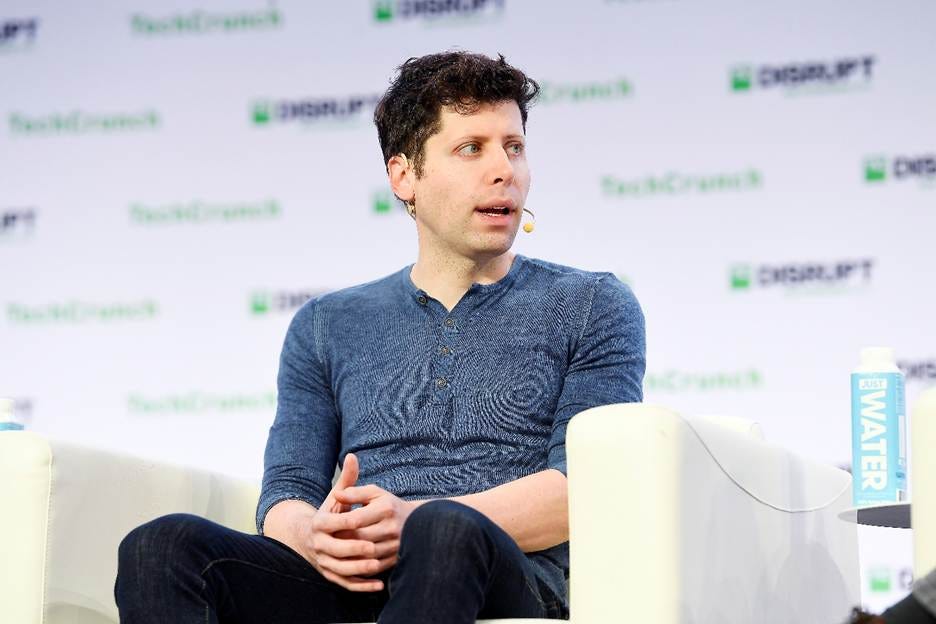
Samuel Harris Altman was born on 22 April 1985 in Chicago and raised primarily in St. Louis, Missouri, the eldest of four children of dermatologist Connie Gibstine and real-estate broker Jerry Altman. At eight he received an Apple Macintosh that helped establish an early interest in computers and programming. Altman attended the John Burroughs School, where at seventeen he publicly came out as gay during a school assembly following controversy surrounding a National Coming Out Day speaker. He entered Stanford University in 2003 to study computer science.
During his sophomore year Altman began developing a mobile location-sharing service originally called Viendo and later renamed Loopt. The project was accepted into the first class of Paul Graham’s Y Combinator in 2005, prompting Altman to leave Stanford and work on the company full time. Loopt allowed mobile-phone users to share their locations with friends and eventually secured agreements with major wireless carriers. The company raised more than $30 million and established Altman within the network of founders and investors forming around Y Combinator.
Loopt nevertheless failed to develop the large consumer audience Altman anticipated. Green Dot acquired the company in March 2012 for approximately $43 million, ending Altman’s first period as a startup founder. He subsequently established the investment fund Hydrazine Capital and became increasingly involved with Y Combinator, first as a part-time partner and then, in February 2014, as Paul Graham’s successor as president. The appointment shifted Altman’s role from building a single company to selecting, financing and advising other founders.
At Y Combinator, Altman sought to expand the accelerator beyond its original model of making small investments in young software companies. He encouraged larger and more technically ambitious ventures and developed YC Research to investigate projects whose time horizons were poorly suited to conventional venture capital. One was a study of universal basic income, reflecting Altman’s growing interest in how automation might redistribute income and employment. He also invested personally in companies including the nuclear-fusion company Helion Energy, while developing the view that inexpensive energy and artificial intelligence could produce large increases in economic output.
Artificial intelligence increasingly displaced Y Combinator as Altman’s principal concern. In 2015 he joined Elon Musk, Greg Brockman, Ilya Sutskever and others in organizing OpenAI, incorporated as a nonprofit in December with the stated objective of developing advanced artificial intelligence for the benefit of humanity. The organization was conceived partly as a counterweight to the concentration of AI talent and computing resources at companies such as Google. Disagreements subsequently developed over OpenAI’s direction and control; Musk departed in 2018, while Altman left the presidency of Y Combinator and became OpenAI’s CEO in 2019.
OpenAI’s increasing need for computing power and capital produced a closer relationship with Microsoft and a departure from its original nonprofit structure. A capped-profit subsidiary was created in 2019, and Microsoft invested $1 billion while making Azure central to OpenAI’s computing infrastructure. OpenAI subsequently released GPT-2, GPT-3, DALL-E, Codex and InstructGPT, demonstrating that increasingly large neural networks could perform tasks in language, programming and image generation. Altman increasingly presented artificial general intelligence (AGI) not simply as a research objective but as a technology capable of reorganizing large parts of economic life.
That possibility also led Altman toward proposals for distributing the wealth he expected AI to create. In his 2021 essay Moore’s Law for Everything, he argued that technological progress would transfer economic power from labor toward capital and proposed an American Equity Fund financed by annual taxes on large companies and privately held land. The proceeds would be distributed to adult Americans in cash and corporate shares. He also backed a guaranteed-income experiment through what became OpenResearch, treating redistribution as one possible response to labor displacement from automation.
The event that transformed Altman’s public position came on 30 November 2022, when OpenAI released ChatGPT. The conversational interface made capabilities developed through the GPT series accessible to a mass audience and generated adoption beyond OpenAI’s expectations. Microsoft announced another multiyear, multibillion-dollar investment in January 2023, followed by the release of GPT-4 on 14 March. Altman consequently moved from being primarily a Silicon Valley executive to becoming a public spokesman for artificial intelligence, appearing before the U.S. Senate in May 2023 and meeting political leaders internationally to discuss AI development and regulation.
His expanding authority concealed a conflict inside OpenAI’s unusual governance structure. On 17 November 2023, the nonprofit board abruptly removed Altman as CEO, stating that he had not been “consistently candid” in his communications and that it had lost confidence in his leadership. Subsequent accounts described disagreements involving his dealings with board member Helen Toner, information provided to directors, and complaints about his management. The attempt to remove him instead demonstrated his support within the company: employees threatened to resign, Microsoft offered Altman a position, and within five days an agreement was reached for him to return. Much of the board responsible for his dismissal was subsequently replaced.
Altman’s restored position coincided with further commercialization of OpenAI. GPT-4o, released in May 2024, expanded ChatGPT’s multimodal voice, image and text capabilities, although its demonstration was followed by a dispute with actress Scarlett Johansson over the similarity between her voice and OpenAI’s “Sky” voice. At the same time, several figures associated with OpenAI’s earlier research culture departed, including co-founder Ilya Sutskever, John Schulman, Mira Murati and Bob McGrew. The departures accompanied a broader transition from the comparatively small research organization founded in 2015 toward a company requiring large amounts of capital, computing infrastructure and energy.
Altman’s ambitions consequently expanded beyond AI models themselves. OpenAI and its partners announced the Stargate infrastructure project in January 2025, while Altman pursued investments and partnerships involving data centers, semiconductors and energy. His investments in Helion and Oklo connected AI development with his longstanding interest in expanding energy supply. In May 2025 OpenAI announced an agreement to acquire io, founded by former Apple designer Jony Ive and others, extending Altman’s plans into dedicated consumer hardware.
OpenAI’s growth has intensified the financial problem implicit in Altman’s ambitions. Building increasingly capable models requires expenditures on chips, electricity and data centers on a scale different from the software businesses of his Loopt and Y Combinator years. By 2025–26 Altman was discussing AI infrastructure in terms measured in hundreds of billions and eventually trillions of dollars, while OpenAI pursued partnerships with governments, technology companies and capital providers. His role had expanded again: from startup founder, to venture investor and accelerator president, to AI executive, and increasingly to an organizer of the physical and financial infrastructure required for large-scale artificial intelligence.
Altman’s private life underwent changes alongside this public expansion. He married Australian software engineer Oliver Mulherin in January 2024 in a private ceremony in Hawaii. Their first son was born through surrogacy in February 2025, and Altman has subsequently spoken about how fatherhood altered his routines and priorities. Altman and Mulherin also signed the Giving Pledge in 2024.
The economic vision surrounding Altman’s AI advocacy has meanwhile shifted in emphasis. His earlier writings offered specific mechanisms for redistributing AI-generated wealth, including taxation of corporate equity and land. More recently, he has placed greater emphasis on making increasingly capable AI broadly and cheaply available, presenting access to intelligence itself as a means of distributing the technology’s benefits. This leaves open the question of how broadly the financial gains from AI will be distributed when ownership of the capital, computing infrastructure and energy required to produce it remains concentrated.
Altman therefore enters his forties in a different position from the entrepreneur who left Stanford to build Loopt. OpenAI now competes with Anthropic, Google DeepMind and increasingly capable Chinese laboratories, while the scale of its plans requires continuing access to outside capital and political cooperation. The trajectory from Loopt through Y Combinator to OpenAI shows a consistent enlargement in the scale of the systems Altman has attempted to organize: first a mobile social network, then a network for creating companies, then an AI laboratory, and finally the capital, energy and computing infrastructure required to develop artificial intelligence on a global scale.
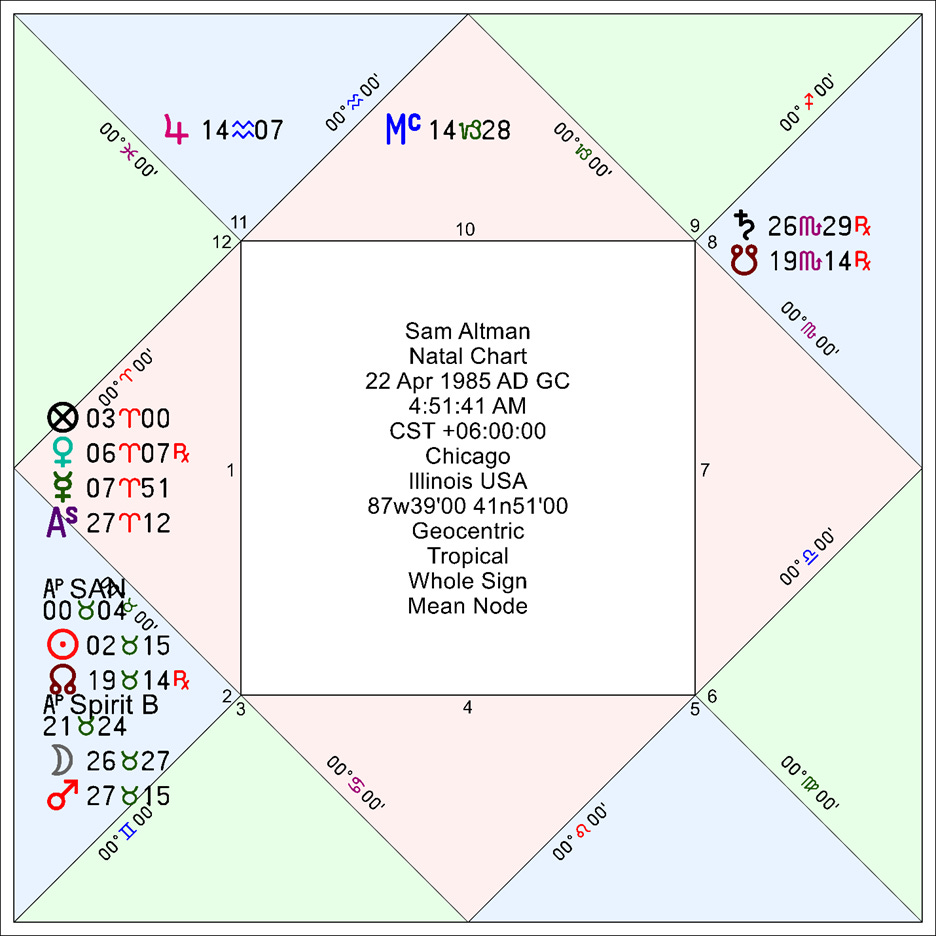
Rodden Rating A, from memory, 5:00 AM, ASC 00TA35
Proposed Rectification: 4:51:41 AM, ASC 27AR12’11”
The analytical models used in the sections below are part of a larger research program developed across longer white papers and case studies, where the historical sources, rules, and testing methodology are laid out in full. These database entries show the models in practice; readers who want the theoretical foundations can start with the background papers below:
Rectification Hub (I wrote the book on it!)
Soul Hub (white paper, Victor model statistical tests, Moon’s Configuration studies)
Physiognomy Hub (white paper, examples)
Victor Model Factors favoring Jupiter/Aquarius
Bound ruler: North Node, Lot of Fortune, Lot of Spirit
House of Joy
Jupiter/Aquarius as Victor. Jupiter in Aquarius describes Altman’s repeated effort to enlarge the benefits of technology beyond the individual and distribute them through networks, institutions, and society at large. Its clearest expression is his conception of AGI as a collective good: OpenAI was founded to develop artificial intelligence for the benefit of humanity, while his earlier universal-basic-income proposals sought to distribute the wealth created by automation through an American Equity Fund, and his more recent position emphasizes giving everyone access to increasingly capable AI. Aquarius also fits the organizational form through which Altman operates—Loopt connected individuals through a technological network, Y Combinator organized networks of entrepreneurs and capital, and OpenAI seeks to build intelligence capable of operating at global scale. Jupiter enlarges each successive undertaking, so that Altman moves from a mobile application to an accelerator, from an accelerator to an AI laboratory, and finally toward energy, computing, data-center, and financial infrastructure measured on a national and international scale. As victor, Jupiter/Aquarius therefore signifies both the scale of Altman’s ambitions and the recurring belief that technological expansion should ultimately produce benefits extending beyond its immediate owners or creators.
Physiognomy Model Factors favoring Aries, Taurus, Aquarius
Rising sign: Aries
Ruler of rising sign: Mars/Taurus
Planets in rising sign: Mercury/Aries, Venus/Aries-retro
Rising decan: Sagittarius
Ruler of rising decan: Jupiter/Aquarius
Altman has a lean, narrow-framed build, with relatively long limbs and little heaviness through the torso; published estimates generally place his height around 5 ft. 6–7 in. (168–170 cm), though this should be treated as approximate. His face is elongated but strongly tapered, widest across the upper cheekbones and temples before narrowing toward a relatively small chin, producing a bony ovate outline rather than a square or fleshy face. The forehead is broad, high, and conspicuously rectangular across its upper portion, while the nose is moderately long and narrow. The mouth provides some contrast to the otherwise lean facial structure, with both lips carrying noticeable thickness relative to the proportions of the nose, cheeks, and jaw.
Astrologically, Aries is the primary physiognomic significator, matching the lean body, spare flesh, prominent bone structure, and especially the bony-ovate face that tapers toward the jaw and chin. Aquarius, occupied by Jupiter as ruler of the rising decan, supplies a secondary modification visible in the broad rectangular forehead, whose upper contour resembles the straight blade of a bulldozer set above the narrower lower face. Finally, Mars/Taurus, ruler of the proposed Aries Ascendant, appears to modify the otherwise dry Aries morphology by adding greater substance around the mouth, particularly the relatively thick lips. The resulting physiognomy combines an underlying Aries form, an Aquarian modification of the forehead, and a localized Taurus influence around the mouth.
Moon’s Configuration
Because Sam Altman is only 41 years old, the Moon’s Configuration cannot yet be matched confidently against the complete trajectory of his life. The first stage can be compared with established biography, but the later stages may describe developments still decades in the future. This is particularly important here because the Moon separates widely from Jupiter, passes through a genuine void-of-course interval, and then encounters an almost exact opposition to Saturn followed immediately by Mars. The biographical matches proposed for Stages 3 and 4 should therefore be understood as prospective scenario analysis rather than claims about events that have already occurred.
Stage 1 — Moon Separates from Jupiter (Aquarius, 11th house)
Delineation. The Moon at 26°27′ Taurus in the 2nd house separates from a wide square to Jupiter at 14°07′ Aquarius in the 11th, establishing Jupiter as the antecedent of the configuration. Jupiter/Aquarius signifies technological expansion directed toward networks, collective interests, and benefits extended across society, while the 11th house reinforces associations with groups, alliances, benefactors, and large social objectives. With Jupiter proposed as victor of the horoscope, the configuration begins from the same planetary principle that organizes much of Altman’s biography: enlargement through technology coupled with an explicitly collective conception of its purpose.
Biographical Match. Altman’s career provides a close match for this Jupiterian antecedent. Loopt sought to connect people through a technological network; Y Combinator enlarged this principle into a network linking entrepreneurs, investors, and new companies; and OpenAI ultimately placed the development of artificial general intelligence for the benefit of humanity at the center of his work. His economic proposals carried the same logic into material affairs. Moore’s Law for Everything argued that the wealth generated by AI should be distributed broadly through an American Equity Fund, while his more recent formulation emphasizes making increasingly powerful AI available to everyone. The Moon’s separation from Jupiter therefore describes an established biographical theme rather than a hypothetical future one.
Stage 2 — Moon Void of Course
Delineation. The separation from Jupiter exceeds the permitted aspect moiety, leaving the Moon void of course before its application to Saturn. This creates an unusual interruption within the configuration: the Jupiterian antecedent does not lead smoothly into the next planetary encounter. A void-of-course interval can signify suspension, discontinuity, loss of direction, or a period during which an established trajectory ceases to produce its expected result. Because the Moon has already separated from Jupiter, the symbolism suggests that the expansive Jupiterian program eventually exhausts itself before the Saturnian stage begins.
Biographical Match. It is too early to identify this interval securely in Altman’s biography. At forty-one, he may still be living primarily within the Jupiterian portion of the configuration, particularly as OpenAI continues to expand its capital requirements, infrastructure plans, international partnerships, and claims for the social benefits of AGI. The void-of-course period could therefore lie substantially ahead. Any attempt to identify current competitive pressures, financing requirements, or changes in OpenAI’s position as the VOC stage would risk imposing the configuration prematurely upon an unfinished life.
Stage 3 — Moon Opposes Saturn (Scorpio-retrograde, 8th house)
Delineation. After the void-of-course interval, the Moon applies to an opposition with Saturn at 26°28′ Scorpio retrograde in the 8th house, an aspect exact to approximately two arcminutes. Saturn is also co-present with the South Node at 19°14′ Scorpio, increasing the potential for deprivation, severance, contraction, or reversal. The opposition across the Taurus–Scorpio and 2nd–8th axes directly confronts personal resources, material security, ownership, and accumulated wealth with debt, external capital, shared resources, obligations, and dependency upon others. Saturn also rules Jupiter/Aquarius, creating a dispositor loop in which the expansive collective project represented by the first stage ultimately answers to the Saturn encountered here.
Biographical Match — Scenario Analysis Only. This stage has not been established biographically and must be treated as speculative. Two scenarios follow from the unresolved behavior of retrograde Saturn. Because Saturn has passed Morning Heliacal Setting and is sufficiently close to opposition with the Sun, the solar-phase model suggests that it may reassert its direct-motion Scorpio behavior. In that case, Saturn signifies national security, secrecy, containment, catastrophic-risk management, and the protection of strategically dangerous resources. The opposition could then describe a future contradiction within Altman’s Jupiterian program: AGI developed for the benefit of everyone becomes sufficiently powerful that governments or its developers conclude that it cannot safely be given to everyone. The universalist Jupiter/Aquarius promise encounters Saturn/Scorpio’s demand to restrict access, protect infrastructure, exclude adversaries, and keep dangerous capabilities contained.
The alternative arises from Saturn’s co-presence with the South Node. If the South Node throws retrograde Saturn across the sign axis despite its solar phase, Saturn may function as Saturn/Taurus: accumulation, hoarding, restriction, taxation, and destruction or confiscation of material wealth. This produces a different but equally literal contradiction. Altman’s original mechanism for sharing the benefits of AGI proposed taxing corporate capital and privately held land to finance universal distributions. Under this scenario, the Jupiter/Aquarius promise of universal prosperity ultimately encounters the problem of who owns the accumulated wealth and how much must be extracted from existing owners to distribute it. The 2nd/8th-house opposition could also manifest through OpenAI itself as a crisis involving external financing, capital obligations, ownership, valuation, or access to the immense pools of other people’s money required to finance its infrastructure.
The two possibilities need not be mutually exclusive. A national-security intervention could restrict foreign investment, computing infrastructure, technology transfer, or access to capital, thereby producing Saturn/Scorpio containment through Saturn/Taurus financial contraction. A particularly useful test approaches with the South Node Firdaria period beginning 22-Apr-2027 and continuing through 22-Apr-2029. With the South Node co-present with Saturn in the 8th house, this period should provide evidence capable of confirming one or both of these Saturn possibilities.
Stage 4 — Moon Conjoins Mars (Taurus, 2nd house)
Delineation. After opposing Saturn, the Moon immediately applies to the conjunction of Mars at 27°15′ Taurus in the 2nd house. Less than one degree separates the Saturn opposition from the Mars conjunction, suggesting that whatever obstruction or reversal Saturn represents is followed quickly by conflict, decisive action, rupture, or struggle over the material affairs of the 2nd house. Mars in Taurus directs conflict toward money, assets, property, ownership, physical resources, and control. Mars is itself ruled by Venus in Aries retrograde, a poorly conditioned dispositor that can redirect the conflict toward damaged alliances, contested agreements, financial relationships, reputation, or other Venusian affairs operating under strain.
Biographical Match — Scenario Analysis Only. This stage is also entirely speculative and may belong to a much later portion of Altman’s life. If the Saturn stage eventually manifests as restrictions on AI or a crisis involving OpenAI’s financing and ownership, the subsequent Mars conjunction suggests that Altman does not passively accept the restriction but enters into a direct struggle over resources or control. Possible manifestations include disputes with investors or business partners, litigation, contested ownership, forced restructuring, battles over access to computing or energy resources, or financial conflict following a contraction in available capital. Because Mars ultimately answers to Venus/Aries retrograde, the conflict could also become entangled with broken partnerships, contractual disputes, reputational controversy, or other damaged Venusian relationships. These are prospective scenarios derived from the configuration, not predictions that can presently be matched to Altman’s biography.
Taken as a whole, the configuration begins with a Jupiterian vision already plainly visible in Altman’s life—technological expansion intended to create collective abundance—but does not promise that this trajectory continues uninterrupted. Jupiter gives way to suspension; suspension eventually encounters an almost exact Saturnian opposition; and Saturn is followed immediately by Mars. Whether those latter stages describe financial contraction, national-security containment, conflict over ownership and resources, or some combination of these remains an open question that can only be tested as the remainder of Altman’s biography unfolds.
Influence of Sect
Sect degrades the Moon’s Configuration, since the horoscope is nocturnal: Jupiter and Saturn are out-of-sect, while Mars and Venus are in-sect. Jupiter out-of-sect weakens the benefic’s ability to deliver its promises cleanly, fitting the limited political acceptance of Altman’s more ambitious proposals for universal income and redistribution of AI-generated wealth; the Jupiter/Aquarius vision may be expansive without becoming a program society is willing to adopt. Saturn out-of-sect is more consequential because it intensifies whichever Saturn scenario ultimately manifests: whether Saturn/Scorpio produces national-security restrictions and containment of AGI, or polarity-shifted Saturn/Taurus produces financial contraction, taxation, or problems involving external capital, the consequences should be comparatively harsh. Mars in-sect, by contrast, produces conflict without requiring catastrophic outcomes: Altman has experienced contentious separations from business partners, most notably Elon Musk, yet these struggles have generally remained institutional, financial, and legal rather than physically destructive.
Venus/Aries retrograde is also in-sect, but beneficence here appears to increase the visibility and scope of troubled Venusian matters rather than eliminate them. An early and relatively trivial example came at Apple’s 9-Jun-2008 developer conference, when Altman appeared onstage with Steve Jobs wearing two polo shirts layered together, with both collars popped—hot pink over fluorescent or lime green; the outfit was sufficiently ridiculed in Silicon Valley that Foursquare later created a “Douchebag” badge whose pink-and-green design and double-popped-collar joke alluded to Altman’s appearance. Much more serious are the sexual-abuse allegations made by his younger sister Annie, which Altman and his family deny, and the accompanying controversy over her financial circumstances. Annie has described periods of housing insecurity, while the Altman family maintains that it provided her with continuing financial assistance, paid expenses, and offered housing support. The controversy nevertheless creates a public tension between Altman’s advocacy of universal economic security and his sister’s account of her own material insecurity. In this sense, in-sect Venus does not suppress the scandalous possibilities of Venus/Aries retrograde; it appears instead to enlarge their manifestation in the public sphere while stopping short of allowing them to overwhelm Altman’s broader career.
Complete biographical chronology, rectification and time lord studies available in Excel format as a paid subscriber benefit. Files is behind the paywall.