

Thomas Hobbes belongs squarely within the Jupiter/Leo series, a group of horoscopes in which this combination repeatedly appears in connection with state-supported religion, an official ideology, or what might more broadly be called the national creed. Jupiter supplies religion, philosophy, doctrine, and systems of belief; Leo raises these principles toward sovereign authority and public recognition. In Hobbes, Jupiter at 7°32′ Leo rules the 9th house of religion and philosophy, occupied by both the Moon and Lot of Fortune, while the Sun—the ruler of Jupiter—is exalted in Aries in the 1st. The result is an unusually concentrated expression of the theme. Hobbes constructed a political philosophy in which the sovereign required authority not only over law and the use of force, but also over the public practice and interpretation of religion. In Part III of Leviathan, his discussion of the Christian commonwealth makes religion part of the problem of sovereignty itself: an independent ecclesiastical authority claiming obedience from the population threatens the unity of the state. The sovereign must therefore possess final authority over public religious doctrine and worship.
In this respect, Hobbes should not be separated too sharply from the explicitly religious examples of Jupiter/Leo. His theology and political circumstances were very different from those of Constantine the Great, but the underlying political structure is comparable: religion is brought within the authority of the state and made supportive of political unity rather than allowed to constitute an independent center of power. Hobbes’s national creed is therefore both philosophical and religious. Leviathan attempts to establish the intellectual principles upon which the commonwealth should rest while simultaneously defining the Christianity compatible with that commonwealth. Jupiter/Leo consequently operates on both sides of its traditional symbolism—Jupiter as philosophy and religion, Leo as sovereign authority.
The Moon’s configuration shows how these principles are joined. The Moon separates from Jupiter/Leo and applies to the exalted Sun in Aries; the Sun in turn rules Jupiter, creating a loop between the creed sanctioned by sovereign authority and the sovereign who possesses the authority to sanction it. Yet the Sun occupies the bound of Saturn, with Saturn in Taurus as bound ruler. Beneath Hobbes’s theory of sovereign authority therefore lies the more elementary problem of material security: without a common power capable of enforcing law, individuals remain exposed to violence, dispossession, and the loss of what they possess. Religion, philosophy, law, and property consequently converge upon the same solution—the establishment of an undivided sovereign capable of maintaining peace.
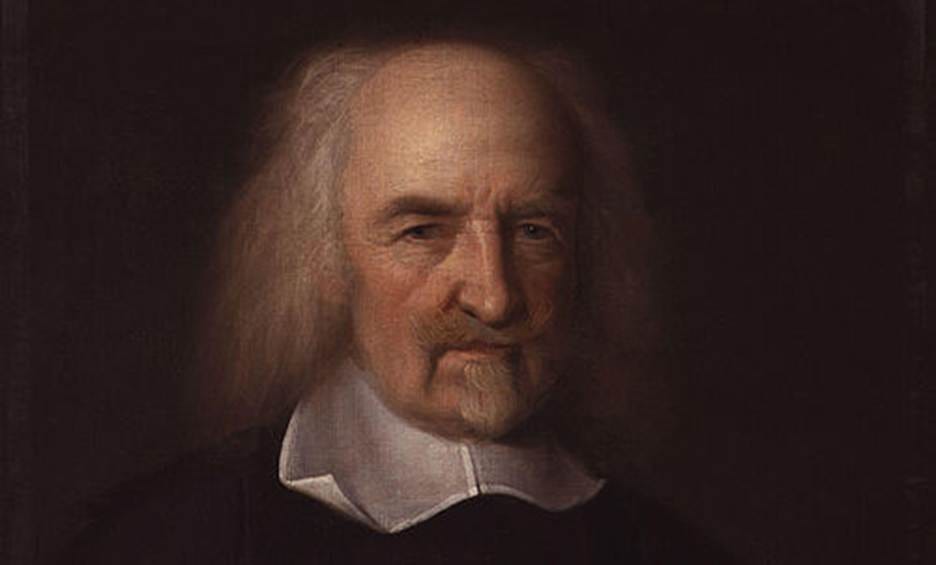
Thomas Hobbes was an English philosopher best known for Leviathan and his defense of undivided sovereign authority. Born at Westport, near Malmesbury, Wiltshire, on 5 April 1588, Hobbes later joked that his mother had given birth to twins: “myself and fear,” because news of the approaching Spanish Armada had frightened her into premature labor. Fear, security, and the lengths people will go to preserve themselves would eventually become central themes of his political philosophy.
Hobbes entered Magdalen Hall, Oxford, around 1603 and received his degree in 1608. His university education was grounded in the traditional Aristotelian curriculum, but he later became deeply hostile to scholastic philosophy. Shortly after leaving Oxford, he entered the service of the Cavendish family, beginning an association that—with interruptions—would provide him with employment, patronage, intellectual contacts, and access to the political elite for much of his life.
Travel proved especially important to Hobbes’s intellectual development. During repeated journeys on the Continent, he encountered the new scientific and philosophical movements that were challenging the inherited Aristotelian worldview. Geometry made a particularly strong impression on him, while his contacts eventually included Marin Mersenne, Galileo Galilei, René Descartes, and other leading figures associated with the new mechanical philosophy. Hobbes increasingly sought to explain nature, human beings, and ultimately politics through matter and motion rather than through the forms, qualities, and final causes characteristic of Aristotelian natural philosophy.
Political turmoil in England gave this intellectual project an immediate practical importance. In 1640, with relations between Charles I and Parliament deteriorating, Hobbes left England for Paris, fearing that his defense of strong monarchical government might expose him to danger. He remained in France for more than a decade. During his exile he published De Cive and developed the political arguments that culminated in Leviathan, published in 1651.
Leviathan presented Hobbes’s most famous argument for political authority. Human beings, he maintained, cannot enjoy lasting security without a common power capable of enforcing peace. The sovereign therefore had to possess sufficient and undivided authority to prevent society from collapsing into conflict. Although Hobbes had close connections with royalists and had briefly served as mathematics tutor to the future Charles II, Leviathan alienated many of them. Hobbes’s theory grounded sovereignty in human agreement and self-preservation rather than divine right and implied that effective protection, rather than hereditary legitimacy alone, was fundamental to political obedience.
Hobbes returned to England in 1651, while the country was governed by the Commonwealth established after the execution of Charles I. After the Restoration of Charles II in 1660, he again enjoyed royal protection, but controversy continued to follow him. His materialism, religious arguments, and unusually broad conception of sovereign power attracted attacks from theologians, mathematicians, political opponents, and former allies. Parliament’s investigation of atheism and profaneness after the Great Fire of London in 1666 heightened his concern that some of his writings might expose him to prosecution.
Hobbes nevertheless remained intellectually active into extreme old age. In addition to political philosophy, he wrote on mathematics, optics, natural philosophy, religion, history, and classical literature, and late in life translated both the Iliad and the Odyssey. He died at Hardwick Hall on 4 December 1679, aged ninety-one, having lived through the Spanish Armada, the Stuart monarchy, the English Civil Wars, the execution of Charles I, the Commonwealth and Protectorate, and the Restoration.
Philosophy in Brief
Hobbes’s philosophy begins with a radical rejection of much of Aristotle’s account of nature. Where Aristotelian philosophy explained the world through substances possessing forms, qualities, purposes, and characteristic powers, Hobbes sought a mechanical explanation based upon body and motion. For Hobbes, whatever genuinely exists is corporeal: reality consists of bodies, and changes in those bodies are motions. This principle extended even to sensation. Color, sound, heat, and other sensible qualities were not incorporeal qualities transmitted from objects into the mind. An external body sets matter in motion; that motion is transmitted through the sense organs and nerves into the body, producing the internal motion that we experience as sensation. The redness we see, for example, does not exist in the external object in precisely the form in which we experience it. What exists outside us is a body whose motions physically act upon our body; “red” is the appearance produced in us by that mechanical interaction. Thought itself therefore had to be explained as part of the physical operations of an embodied human being rather than as the activity of an immaterial soul existing independently of matter.
The same unsentimental view of human nature underlies Hobbes’s political philosophy. Human beings naturally pursue what they desire and avoid what they fear, with self-preservation providing the most fundamental motive. Because people compete for resources, distrust one another, seek advantage, and care about status and reputation, a population without a common authority is perpetually vulnerable to conflict. Hobbes called this hypothetical condition the state of nature. It did not mean that everyone would literally be fighting at every moment; rather, everyone would possess the ability and incentive to use force whenever necessary, while nobody could rely upon a superior authority for protection. The result was the famous condition in which there could be “no security to any man,” and life threatened to become “solitary, poor, nasty, brutish, and short.” Rational people therefore agree to surrender their individual right to decide when force should be used and authorize a sovereign to maintain peace. Because divided sovereignty recreates the competing centers of power that produce civil war, Hobbes favored an absolute and undivided sovereign—preferably a monarch—whose authority was strong enough to prevent society from returning to the insecurity from which political government had rescued it.
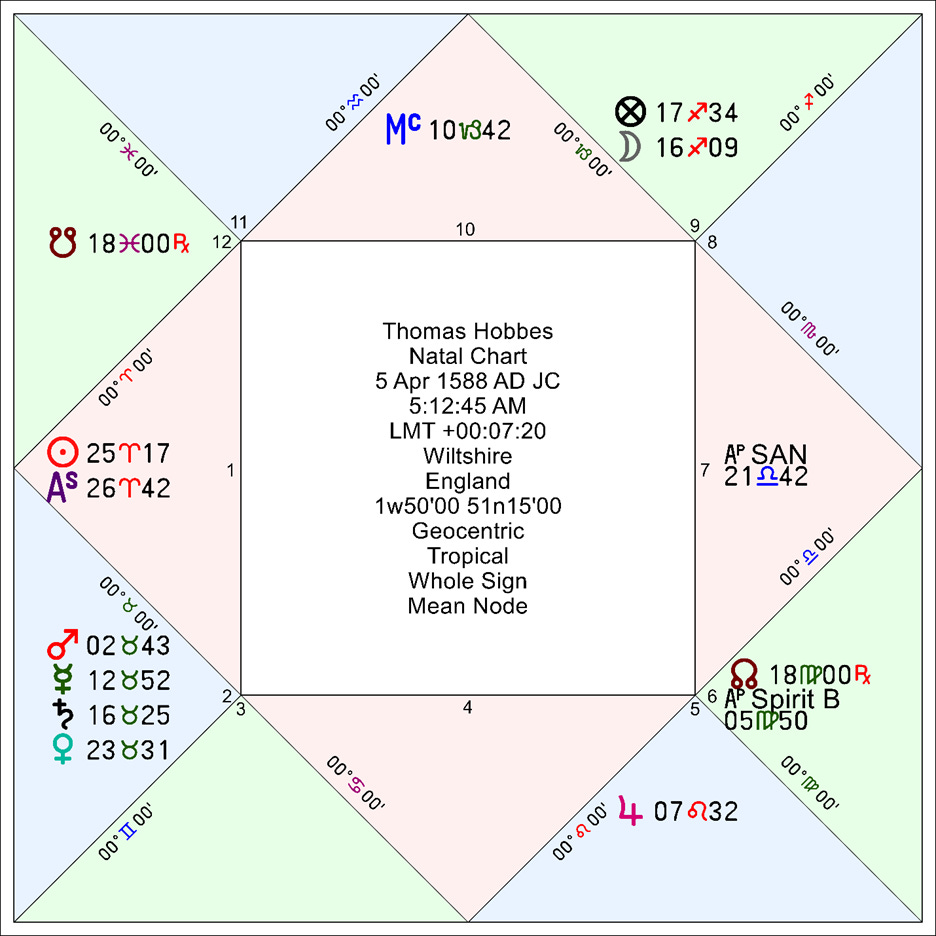
Rodden Rating C, Rectified from Approx Time, 5:00 AM, ASC 20AR00
https://www.astro.com/astro-databank/Hobbes,_Thomas
Proposed rectification: 5:12:44 AM, ASC 26AR42’27”
The analytical models used in the sections below are part of a larger research program developed across longer white papers and case studies, where the historical sources, rules, and testing methodology are laid out in full. These database entries show the models in practice; readers who want the theoretical foundations can start with the background papers below:
Rectification Hub (I wrote the book on it!)
Soul Hub (white paper, Victor model statistical tests, Moon’s Configuration studies)
Physiognomy Hub (white paper, examples)
Victor Model Factors favoring Jupiter/Leo
Sign ruler: Moon, Lot of Fortune
Bound ruler: Midheaven
Jupiter at 7°32′ Leo in the 5th house is the Victor of Hobbes’s horoscope. It rules the 9th house of philosophy, occupied by both the Moon at 16°09′ Sagittarius and the Lot of Fortune at 17°34′ Sagittarius, strongly concentrating the life around philosophy, higher learning, and the construction of an encompassing intellectual system. Jupiter/Leo has repeatedly shown itself as a combination concerned with the elevation of religion, philosophy, or a system of belief to a position of public authority—the official creed of a society, whether religious or secular. Hobbes provides an unusually direct political expression of this symbolism. His philosophy did not remain a private speculation about human nature: it culminated in Leviathan, an attempt to establish the principles upon which the entire political order should rest, with an absolute sovereign possessing the authority to determine the public framework of law, religion, and permissible doctrine. The Firdaria strongly reinforce Jupiter’s position as Victor. Jupiter minor periods repeatedly coincided with important stages in Hobbes’s education and intellectual development, while the Jupiter major period of 1639–1651 encompassed the decisive transformation of his career—The Elements of Law, his flight to Paris, De Cive, his exchange with Descartes, his tutorship of the future Charles II, and finally the composition and publication of Leviathan.
Physiognomy Model Factors favoring Leo, Sagittarius
Rising sign: Aries
Ruler of rising sign: Mars/Taurus
Panets in rising sign: Sun/Ares
Rising decan: Sagittarius
Ruler of rising decan: Jupiter/Leo
Planets in rising decan: Moon/Sagittarius
Contemporary accounts describe Hobbes as a man of generally sound constitution who remained physically active well into old age. In the portrait, the head and face are distinctly longer than wide, with a broad forehead, relatively straight sides through the temples and cheeks, and a lower face that terminates in a strong, squared jaw and prominent chin. The nose is long and substantial, the brow pronounced, and the eyes deep-set beneath it. His long hair adds width around the upper head, but the underlying facial structure remains relatively straight-sided rather than round or tapered. The surviving portraits of Hobbes at different ages preserve much the same basic structure: a long, substantial head, broad upper face, and strongly defined lower jaw.
Aries rises, with the Ascendant falling in the Sagittarius decan and Jupiter therefore ruling the rising decan. Sagittarius appears as a secondary physiognomy significator in the pronounced length of Hobbes’s face; in John Willner’s model, Sagittarius, together with Gemini, produces the longest facial proportions and is also associated with greater bodily height. The more distinctive structural signature, however, comes from Jupiter at 7°32′ Leo. Willner assigns Leo a rectangular head, and Hobbes corresponds closely to this type: the elongated face retains relatively straight sides, a broad upper portion, and a conspicuous squared jaw and chin rather than tapering toward the bottom. The combination is therefore quite specific: Sagittarius supplies the length, while Jupiter/Leo supplies the rectangular shape and powerful jawline.
Moon’s Configuration
Stage 1. Moon Separates from Jupiter/Leo
Delineation. The Moon at 16°09′ Sagittarius in the 9th house separates by trine from Jupiter at 7°32′ Leo in the 5th. Jupiter rules the 9th house itself and is the Victor of the horoscope, making philosophy, religion, higher learning, and systems of belief central to the configuration. Jupiter/Leo describes the elevation of a philosophy, religion, or system of belief to the status of an authoritative public creed. Jupiter is placed in the bound of Venus, with Venus in Taurus as bound ruler, adding an underlying concern with peace, material security, property, and the stable enjoyment of worldly goods.
Biographical Match. Hobbes devoted his mature life to constructing a comprehensive philosophical system intended to explain not merely nature and human behavior but the proper organization of society. Leviathan represents the fullest expression of Jupiter/Leo: political philosophy elevated into a theory of the authoritative creed by which the state should be governed. Hobbes assigned the sovereign extensive authority over law, public doctrine, and religion because competing sources of authority threatened the peace of the commonwealth. The Venus/Taurus bound rulership fits the material purpose underlying this system. Political authority ultimately exists so that human beings can escape insecurity and enjoy peace, property, and the fruits of their labor without constant fear of their loss.
Stage 2. Moon Applies to Sun/Aries
Delineation. After separating from Jupiter, the Moon applies by trine to the Sun at 25°17′ Aries in the 1st house. Sun/Aries presents an unusually concentrated image of autonomous and commanding authority: a single center of power capable of acting decisively rather than depending upon competing authorities. Yet the Sun occupies the bound of Saturn, whose bound ruler is Saturn in Taurus. Beneath the sovereign Sun therefore lies Saturn/Taurus: restriction, deprivation, fear of loss, and insecurity surrounding property and material possessions. The Sun becomes the power capable of imposing order upon this condition.
Match. This closely describes Hobbes’s movement from political philosophy to his doctrine of the absolute sovereign. His state of nature is a condition in which individuals possess desires, resources, and physical possessions but lack an authority capable of guaranteeing their continued possession. Property in the secure legal sense depends upon the commonwealth: without an enforceable law, another person may simply take what one possesses. Saturn/Taurus therefore appears as the material insecurity underlying Hobbes’s political theory, while Sun/Aries describes his solution—a sovereign sufficiently powerful to suppress private violence, enforce agreements, determine law, and transform precarious possession into secure property. Fear of dispossession, violence, and ultimately death drives individuals toward sovereign authority.
Stage 3. The Sun Rules Jupiter: The Loop
Delineation. The configuration does not end when the Moon reaches the Sun, because the Sun rules Jupiter in Leo, the planet from which the Moon originally separated. The Moon therefore moves from Jupiter/Leo to Sun/Aries only to discover that the Sun disposits Jupiter, creating a closed circuit between the two planets. Jupiter signifies the philosophy or authoritative creed, while the Sun signifies the sovereign power that gives that creed political reality. Neither principle stands entirely apart from the other: the philosophy explains and legitimates sovereign authority, while sovereign authority establishes and maintains the political order described by the philosophy.
Biographical Match. This loop is particularly descriptive of Leviathan. Hobbes begins with a philosophical account of matter, sensation, human desire, fear, competition, and self-preservation and uses it to demonstrate why sovereign government is necessary. Yet the culmination of that philosophy is the sovereign itself, which possesses the authority required to maintain the legal and doctrinal order of the commonwealth. Jupiter/Leo thus produces the intellectual system of sovereign authority, while its ruler Sun/Aries embodies the sovereign at the center of that system. Hobbes’s philosophy leads to sovereignty, and sovereignty becomes the mechanism through which the philosophical objective—peace and security—is realized.
Infuence of Sect
The horoscope is diurnal, placing both Jupiter and Saturn in sect and improving the operation of the Moon’s configuration. Jupiter in sect strengthens the constructive side of Jupiter/Leo: philosophy, law, political order, and an authoritative public creed are given greater scope and legitimacy, appropriate to Hobbes’s attempt to build a comprehensive philosophical foundation for government. Saturn’s being in sect is equally important because Saturn/Taurus lies beneath both stages of the configuration through the bounds. Rather than allowing fear of deprivation, dispossession, and material insecurity to become merely destructive, an in-sect Saturn makes these dangers more manageable through restraint, structure, law, and durable institutions. The configuration therefore moves toward a solution rather than remaining trapped in the problem: Jupiter formulates the principles of political order, while Saturn defines the material insecurity that makes such order necessary. In Hobbes’s philosophy, fear of losing property, security, and ultimately life becomes the rational basis for accepting the restrictions imposed by sovereign government.
Early/Late Bloomer Thesis
Hobbes was born after a Full Moon and therefore, under the early/late bloomer model, should be a late bloomer, with the more consequential portion of his life and career falling after the midpoint. He lived from 1588 to 1679, a longevity of approximately 91 years, placing his midpoint at about 45½ years of age, in 1633–34. The model works unusually well. Before the midpoint, Hobbes had received his education, entered the service of the Cavendish family, traveled extensively, and begun developing his intellectual interests, but he had not yet produced the works upon which his historical reputation rests. The years immediately surrounding and following the midpoint brought the decisive transition: his encounter with continental mechanical philosophy intensified during the 1630s; The Elements of Law followed in 1640, De Cive in 1642, and Leviathan in 1651. His major controversies with Descartes, Bramhall, and others likewise belong to the second half of life, as did his continuing work in political philosophy, religion, mathematics, history, and translation. Hobbes therefore provides a strong example of the late-bloomer pattern: the first half of his unusually long life supplied education, patronage, travel, and intellectual preparation, while after the midpoint of approximately 1634 he emerged as the philosopher whose mature works established his lasting reputation.
Complete biographical chronology, rectification and time lord studies available in Excel format as a paid subscriber benefit. Files are behind the paywall.