

This post continues the Jupiter in Cancer series, a sequence of charts that test how Jupiter in Cancer—especially when retrograde—often behaves less like abundance and shelter and more like Jupiter in Capricorn: moral gravity, limits on care, and the failure of institutions meant to protect. W. H. Auden belongs in this lineage. He was born only about a week before Jupiter’s direct station in Cancer, yet his life shows little of the easy providence traditionally associated with Jupiter in this sign. Instead, the dominant pattern is disillusionment with collective moral shelter and the repeated exposure of how political movements, nations, and ideologies fail to provide the care they promise. This case helps sharpen the working thesis of the series: proximity to a station does not erase the lived reality of Jupiter retrograde, which in practice often inverts Cancer’s promise of protection into encounters with moral coldness, breakdown of nurture, and the need to rebuild meaning inwardly.
In Auden’s chart, Jupiter in Cancer emerges as the victor of the horoscope, shaping both the arc of his reputation and the central problems of his life. His early rise as a leading poetic voice of the interwar generation rests on diagnosing social collapse and moral disorientation, exposing the failure of institutions meant to safeguard human dignity. The Spanish Civil War becomes a hinge of this pattern: what first appears as a collective moral struggle reveals itself as ethically compromised, leading Auden to later repudiate his own political rhetoric. The move to America on the eve of World War II, widely criticized as a withdrawal from national obligation, continues the same story of Jupiterian shelter failing at the collective level, followed by a turn toward religious reflection and private conscience as the remaining ground for moral coherence. The promise of care is not abolished, but it is withdrawn from movements and relocated inward.
The sect condition of the chart further clarifies why Auden’s moral authority peaks in moments of crisis and narrows in periods of stability. With Jupiter and Saturn out of sect in a nocturnal figure, his diagnoses of moral decay and institutional failure resonate strongly in the breakdown years of the 1930s and early 1940s, yet become increasingly out of phase with the postwar world of economic expansion and democratic optimism. His cultural reach shifts from generational leadership to a more specialized authority among poets, theologians, and moral thinkers. By contrast, the in-sect condition of Venus and Mars helps explain why themes of love, intimacy, and moral conflict remain emotionally compelling throughout his career, even as his broader moral voice becomes more austere and less culturally central.
Taken together, Auden’s life provides another useful case in this series for examining how Jupiter in Cancer retrograde tends to function less as comfort and more as the exposure of failed comfort—less as shelter and more as the recognition that shelter offered by collective moral frameworks is unreliable. The victor of the horoscope does not confer ease so much as impose the task of confronting broken systems of care and rebuilding ethical life on narrower, more inward foundations. Auden’s trajectory—from public moral firebrand to critic of ideological righteousness, and finally to a poet of private conscience and religious seriousness—fits this Jupiterian pattern closely, without implying that his case is more decisive or exemplary than others in the series.
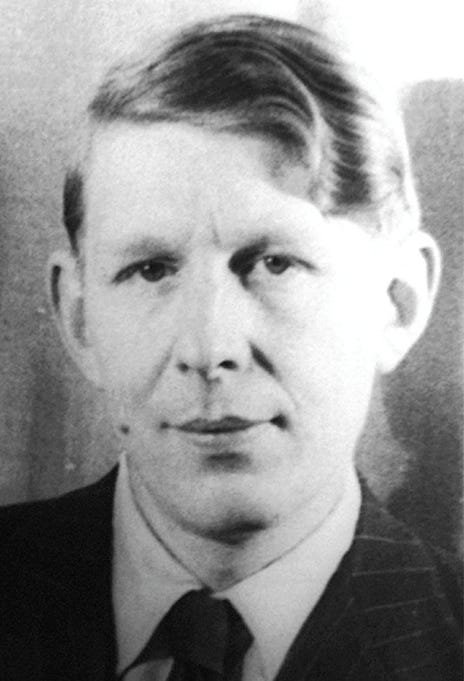
W. H. Auden was born in 1907 in York, England, into a household shaped by science, medicine, and the Anglican Church. His father was a physician with a keen interest in psychology and folklore; his mother was a trained nurse whose strong moral seriousness and religious devotion left a lasting imprint on her son. Auden grew up in Birmingham during the First World War, absorbing early impressions of industrial landscapes, social class divisions, and the looming presence of modern mass conflict. As a child he was fascinated by geology, mining landscapes, and machinery—interests that later surfaced in his poetry as metaphors for inner life, labor, and the hidden structures beneath ordinary appearances.
At Oxford in the late 1920s, Auden found his voice amid a circle of young writers who would later be called the “Auden Group,” including Stephen Spender, Cecil Day-Lewis, and Louis MacNeice. His early poems fused technical virtuosity with political urgency, diagnosing social breakdown, emotional paralysis, and the psychological wounds left by war and industrial modernity. These poems carried an unusual combination of cool detachment and urgent moral pressure, as though the poet were both clinician and witness. By the early 1930s, Auden had become a central figure in British poetry, widely regarded as the most important poetic voice of his generation.
The political crises of the 1930s drew Auden toward public engagement. He traveled to Berlin in the waning years of the Weimar Republic, witnessed the rise of fascism at close range, and later went to Spain during the Civil War, where his brief involvement with the Republican cause sharpened his sense of ideological disillusionment. Although sympathetic to leftist politics, Auden grew increasingly wary of propaganda and the moral simplifications demanded by political movements. His famous poem “Spain 1937” was later partially repudiated by Auden himself, who came to distrust poetry written in the service of political righteousness rather than human truth.
In 1939, on the eve of the Second World War, Auden left England for the United States, a move that provoked intense controversy among British intellectuals who viewed his departure as moral desertion. Settling first in New York and later dividing his time between the U.S. and Europe, Auden underwent a profound personal and spiritual transformation. He returned to Christian faith, abandoned overtly political rhetoric in his poetry, and increasingly turned toward ethical reflection, love, private responsibility, and the limits of human power. The poem “September 1, 1939,” written in New York at the outbreak of war, captured both the public anxiety of the moment and Auden’s emerging skepticism toward grand historical narratives.
Auden’s later work became more philosophical, more formally intricate, and more inwardly demanding. He explored themes of eros, friendship, vocation, time, and moral choice, often adopting conversational, even prosaic tones that masked complex formal structures beneath the surface. His long partnership with the younger poet Chester Kallman shaped both his emotional life and his creative output, though the relationship was marked by instability and emotional asymmetry. Teaching posts, lecture tours, and editorial projects turned Auden into a public intellectual of unusual breadth, equally at home discussing Kierkegaard, opera libretti, medieval theology, and modern psychology.
By the time of his death in 1973, Auden’s reputation had shifted from that of a political firebrand to that of a moral diagnostician of modern life. His career traced a movement away from collective ideology toward personal conscience; away from historical prophecy toward the difficult, often unglamorous work of ethical self-examination. Few twentieth-century poets combined such technical command with such restless self-revision. Auden’s legacy lies not only in his poems but in his willingness to repudiate his own earlier certainties, modeling an intellectual honesty that placed truth above reputation or factional loyalty.
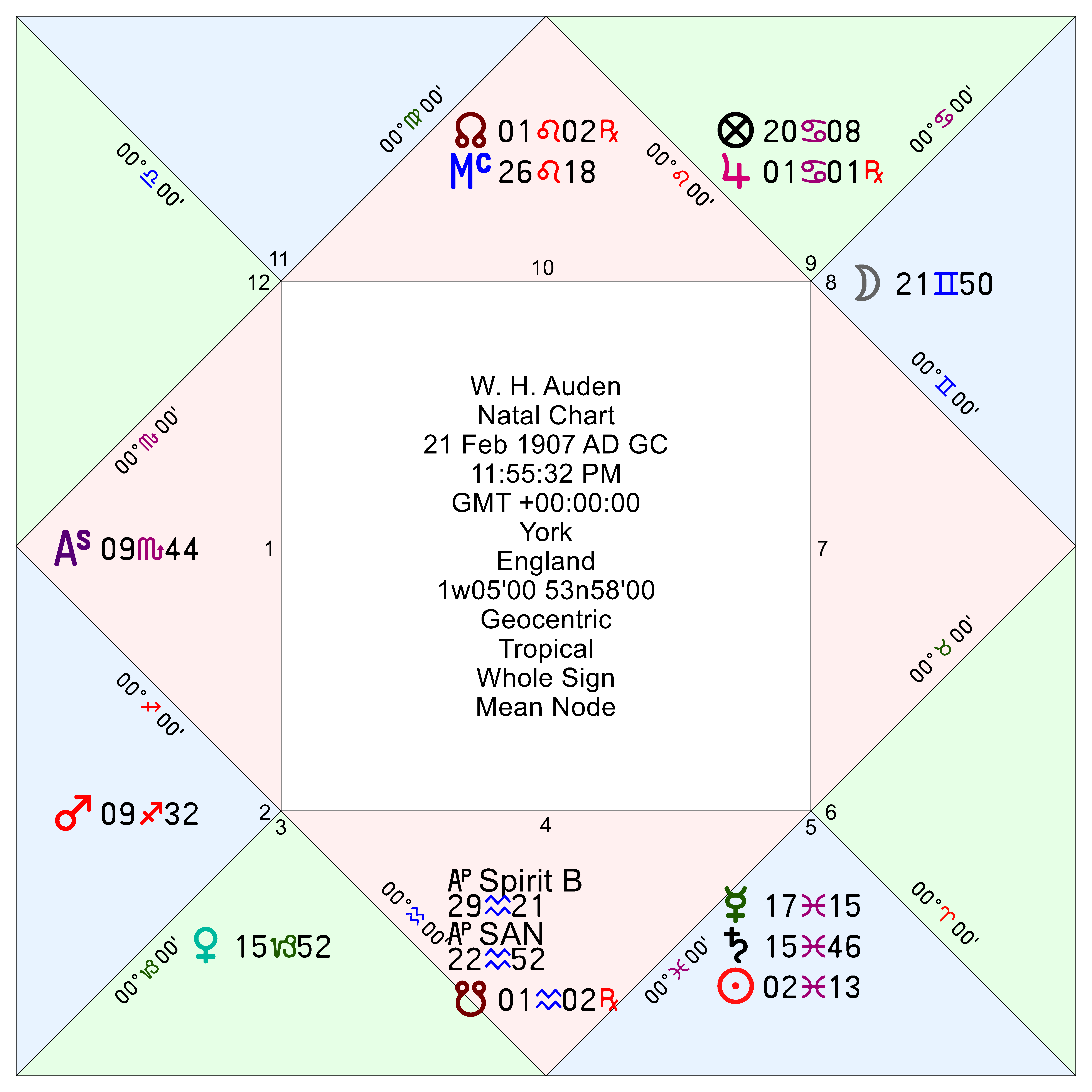
Rodden Rating DD, Conflicting/unverified, 11:00 PM, ASC 00SC21.
Proposed rectification: 11:55:32 PM, 9SC44’50”
The analytical models used in the sections below are part of a larger research program developed across longer white papers and case studies, where the historical sources, rules, and testing methodology are laid out in full. These database entries show the models in practice; readers who want the theoretical foundations can start with the background papers below:
Soul Hub (white paper, Victor model statistical tests, Moon’s Configuration studies)
Physiognomy Hub (white paper, examples)
Victor Model Factors favoring Jupiter/Cancer – retrograde
· Sign ruler: Sun
· Bound ruler: Lot of Fortune
· Direct Station: within 7 days
· Co-present with Lot of Fortune
W. H. Auden’s life and reputation are best explained by Jupiter in Cancer retrograde as the victor of the horoscope, ruling his identity, vocation, and moral authority while itself being compromised in its natural promise of care, shelter, and ethical coherence. His early fame was built on diagnosing social breakdown in late-industrial Britain, exposing the failure of institutions meant to protect and nurture the vulnerable, and offering moral frameworks that were quickly tested by the crises of fascism and civil war in Europe. The Spanish Civil War proved decisive: his initial sympathy for the Republican cause curdled into disillusionment with ideological righteousness itself, leading him to later repudiate parts of his own political poetry as morally misleading. This same pattern repeated in his move to America on the eve of World War II, widely criticized as a betrayal of national duty, yet followed by a retreat from political prophecy into religious reflection and ethical self-examination, as though the promise of moral shelter had to be withdrawn from collective movements and rebuilt inwardly, through private conscience, faith, and responsibility.
Physigonomy Model Factors favoring Sagittarius, Scorpio
Rising sign + rising decan = Scorpio
Ruler of rising sign + ruler of rising decan = Mars/Sagittarius
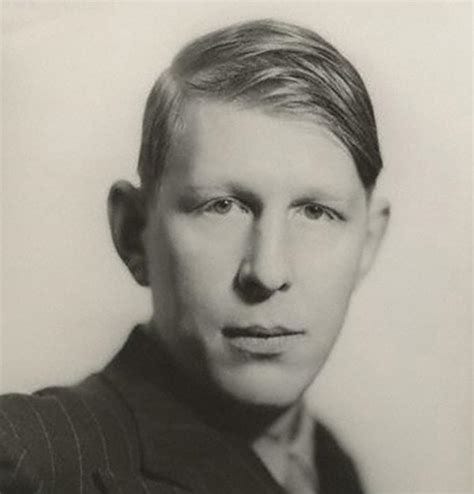
In photographs from early adulthood through middle age, Auden presents a lean, somewhat elongated physical type rather than the compact, block-like figure suggested by his later years. He stood approximately 5 feet 10 inches (178 cm), of average height but with a long neck, narrow shoulders, and an overall verticality that becomes evident when viewing full-body photographs. The face is noticeably longer than it is wide, tapering from a broad forehead toward a relatively narrow jaw. The nose is prominent and projects strongly from the face, while the mouth is thin and restrained, often set in a neutral or slightly compressed expression. The eyes are deep-set and observant, creating an impression of watchfulness rather than sociability. Only in later life, after decades of smoking, aging, and the deep furrowing of the skin for which he became famous, does the face acquire the heavier, almost block-like appearance that dominates popular memory. The underlying structure, however, remains fundamentally elongated rather than square, with the vertical dimensions of the skull and face continuing to outweigh their breadth.
From an astrological physiognomy standpoint, the photographs suggest that Mars in Sagittarius, as ruler of both the Ascendant and the rising decan, exerts a stronger influence on appearance than Scorpio alone. Scorpio rising contributes the penetrating gaze, emotional reserve, and underlying intensity visible throughout his life, particularly in the deep-set eyes and tendency toward inward concentration. Yet the dominant bodily signature is Sagittarian: the elongated facial proportions, long neck, prominent nose, and generally vertical construction of the figure are more characteristic of Sagittarius than of the compact rectangular forms often associated with Scorpio. The later heaviness of the face initially points toward Scorpio, but comparison of photographs across the lifespan indicates that this effect is largely a product of age, weathering, and deeply etched wrinkles rather than original bone structure. The physiognomy therefore appears to express a Sagittarian framework animated by a Scorpionic temperament—a Mars-ruled face in which Sagittarius supplies the form while Scorpio supplies the psychological atmosphere.
Moon’s configuration
Phase I – Moon separating from Mercury (Pisces, 5th House)
Delineation. The Moon separating from Mercury in Pisces describes a temperament formed through observation, reflection, and emotional permeability rather than direct immersion in collective feeling. Mercury in Pisces gives a voice attuned to diffuse moods, moral atmospheres, and the unspoken anxieties of the surrounding environment, while its proximity to Saturn introduces gravity, restraint, and a tendency toward seriousness or melancholy. Even as the Moon moves away from this conjunction, the emotional tone remains shaped by a sense of weight, disillusionment, and moral sobriety. The separation suggests a life trajectory that begins from a stance of reflective distance, where perception and articulation precede emotional participation, and where the individual often occupies the role of diagnostician rather than partisan.
Biographical Match. Auden’s early poetry establishes him as a detached observer of social and emotional breakdown rather than a lyric confessor or romantic celebrant. His voice in the late 1920s and early 1930s carries a clinical, almost analytical quality, describing paralysis, alienation, and moral confusion in modern society with cool precision. Even when engaging political themes, he positions himself as one who surveys the crowd rather than dissolving into it, cultivating a reputation as a poet who names the failures of his age without offering sentimental comfort. This stance gives his early work its distinctive authority and also its underlying loneliness: he speaks from within the crisis while standing emotionally apart from its collective enthusiasms.
Phase II – Venus sextile Saturn
Delineation. The Venus–Saturn sextile binds love to seriousness, responsibility, and endurance rather than ease or pleasure. Affection here is not imagined as spontaneous fulfillment but as something that must coexist with limits, disappointment, and obligation. This aspect stabilizes attachment through acceptance of burden, producing a relational style that values loyalty, continuity, and moral weight over romantic idealization. The emotional economy formed by this aspect tends to express care through endurance and commitment rather than warmth or ease, and it links intimacy with ethical responsibility.
Biographical Match. Auden’s personal relationships and poetic treatment of love consistently emphasize endurance rather than romantic fulfillment. His long partnership with Chester Kallman, though emotionally asymmetrical and often painful, persisted over decades and became a defining structure of his private life. In his poetry, love is rarely portrayed as redemptive bliss; instead, it appears as something that must be carried alongside suffering, disappointment, and moral constraint. Affection is real but never uncomplicated, and intimacy is portrayed as inseparable from duty, limitation, and the sober recognition of human imperfection.
Phase III – Moon changing signs from Gemini to Cancer
Delineation. The Moon’s change from Gemini to Cancer marks a shift from an emotionally mediated, observational mode toward a more vulnerable engagement with the need for care, belonging, and shelter. The earlier emphasis on description, analysis, and framing gives way to a deeper confrontation with emotional dependency and the longing for protection or moral home. This transition signals that emotional life can no longer remain primarily cognitive or detached; the question of where one belongs, who provides shelter, and how care is sustained becomes central. The movement suggests a passage from diagnosis toward implication, where the individual must now grapple personally with the conditions previously analyzed at a distance.
Biographical Match. In Auden’s life, this shift corresponds to his movement away from merely describing social collapse toward confronting the deeper problem of where moral and emotional shelter might be found. The crises of the 1930s force him to recognize that observation alone is insufficient; the question of care—social, moral, and spiritual—becomes unavoidable. His growing discomfort with ideological certainty reflects this turn inward, as he becomes less satisfied with standing apart as a commentator and more compelled to confront the personal consequences of living within a world whose institutions of care have visibly failed.
Phase IV – Moon applying to Jupiter (Cancer, retrograde, 9th house)
Delineation. The Moon’s application to Jupiter retrograde in Cancer describes a search for moral shelter, meaning, and protection that encounters disappointment, reversal, or internal conflict. Jupiter promises coherence, ethical authority, and belonging within a larger framework of belief, but its retrograde condition in Cancer indicates that these promises are compromised, withdrawn, or forced inward. The emotional movement here seeks refuge in moral or spiritual systems yet finds that collective structures of care are unreliable. The co-presence with the Lot of Fortune gives this sequence public and vocational weight, marking the pursuit and subsequent reworking of moral shelter as central to reputation and life direction.
Biographical Match. Auden’s disillusionment with the moral simplifications of political movements, especially following the Spanish Civil War, embodies this pattern precisely. What had initially appeared as a source of ethical clarity and collective care revealed itself as morally compromised, prompting him to later repudiate parts of his own political poetry. His move to America on the eve of World War II, widely criticized as a withdrawal from national obligation, further reflects this turning away from collective moral shelter. In the years that followed, his turn toward religious reflection and private conscience represents a reconstitution of meaning after the failure of public moral frameworks, as the search for care and ethical grounding is relocated inward rather than entrusted to movements, nations, or ideologies.
Influence of Sect
Because Auden’s horoscope is nocturnal, Jupiter and Saturn operate out of sect, which helps explain both the power and the limits of his moral authority as a poet. His great period of cultural influence coincides with moments of crisis and social breakdown, when themes of moral decay, institutional failure, and ethical disorientation resonate widely; yet in the postwar world of economic expansion and democratic confidence, this same moral gravity increasingly feels out of phase with the prevailing mood. As a result, his reach narrows from that of a generational voice to that of a respected but more specialized moral diagnostician, read deeply by intellectual and religious audiences rather than embraced as a broad cultural leader. Saturn’s out-of-sect condition sharpens the austerity of his ethical vision, giving his later work a tone of burden and judgment that resists easy cultural absorption. By contrast, Venus and Mars being in sect helps explain why themes of love, intimacy, and moral conflict remain emotionally compelling in his work, with Mars in Sagittarius finding especially clear expression in the confrontational travel narratives and ideological testing of Journey to a War and the political drama of The Ascent of F.6, while Venus in Pisces shows up in his sustained, compassionate treatment of flawed love and emotional dependency in poems such as “Lullaby” and the later love sequences addressed to Chester Kallman, where tenderness and vulnerability remain among the most accessible and enduring elements of his work.
Early/Late Bloomer Thesis
Born in 1907 and dying in 1973, Auden’s lifespan of 66 years places the midpoint of his life at age 33, or the year 1940, which provides a clean test of the early/late bloomer thesis for a birth just after a New Moon. The decisive formation of his public identity and reputation occurs well before this midpoint: by the late 1920s and early 1930s he has already emerged as the leading poetic voice of his generation, established the Oxford circle, published the work that defines his early reputation, engaged the political crises of the interwar years, and achieved international prominence by the time he leaves England for the United States in 1939. After 1940, the trajectory shifts from ascent to reorientation and consolidation, as he retreats from public political prophecy into religious reflection, ethical diagnosis, and formal experimentation, with his cultural centrality narrowing even as his intellectual depth and authority continue to grow. The biographical record therefore supports the early bloomer prediction cleanly: the life-defining rise occurs before the midpoint, while the post-midpoint years are marked by revision, inward turn, and consolidation rather than initial emergence.
Complete biographical chronology, rectification and time lord studies available in Excel format as a paid subscriber benefit. Files are behind the paywall.