

William J. Bennett occupies a prominent place in the continuing Jupiter/Leo series examining the “creed of the nation”—the principles, values, and moral obligations that a society seeks to establish as its common inheritance. As secretary of education under Ronald Reagan and subsequently drug czar under George H. W. Bush, Bennett became a leading advocate of traditional morality, academic standards, and personal responsibility. His efforts to restore a common cultural framework placed him at the center of the American culture wars of the 1980s, when disputes over education, sexuality, drugs, and national identity increasingly divided the country.
Bennett also provides a historical introduction to Peter Thiel, whose natal horoscope will appear tomorrow, October 28. Both men have Venus/Virgo, a configuration associated in this study with problems involving morality and vice, including the tendency toward strict moral prescriptions. Both were active participants in the culture wars, although at very different stages of their careers. Their paths crossed on April 18, 1988, when The Stanford Review, edited by the young Thiel, joined other conservative student organizations in hosting a speech by Bennett at Stanford University. Bennett criticized the university’s decision to revise its required Western Culture curriculum, replacing a fixed reading list of Western classics with a broader program incorporating works concerning women, minorities, and non-Western cultures.
The controversy attracted national attention. The following day, The Washington Post reported Bennett’s denunciation of Stanford’s decision and identified Thiel, then a junior and editor of The Stanford Review, among those supporting his position. Thiel argued that political pressure had influenced the university’s decision, while Stanford administrators maintained that the changes followed extensive faculty deliberation. For Bennett, the dispute represented another battle over America’s cultural inheritance. For Thiel, it was an early encounter with the national conservative movement, foreshadowing his later involvement in political and ideological debates.
The present horoscope examines Bennett’s proposed nocturnal nativity, with Venus/Virgo as Victor, Saturn/Gemini attempting to regulate Venusian matters through institutional authority, and Jupiter/Leo supplying the national moral creed. Bennett’s career also reveals the difficulties of maintaining such standards, most notably in the 2003 controversy over his high-stakes gambling. The result is a biography in which the public enforcement of virtue and the private experience of vice become competing expressions of the same planetary configuration.

William John Bennett was born on July 31, 1943, in Brooklyn, New York, into a middle-class Catholic family. His family subsequently relocated to Washington, D.C., where he attended Gonzaga College High School, a Jesuit institution. Bennett earned a bachelor’s degree in philosophy from Williams College in 1965, a doctorate in political philosophy from the University of Texas in 1970, and a law degree from Harvard University in 1971. His combination of philosophical training, religious upbringing, and legal education would inform a public career devoted to the relationship between morality, education, and government.
After teaching philosophy and working in university administration, Bennett became an assistant to Boston University president John Silber, whose outspoken defense of academic standards provided an early model for Bennett’s subsequent career. In May 1976, Bennett moved to the newly established National Humanities Center in North Carolina as executive director, becoming its president in 1979. His work attracted the attention of the incoming Reagan administration, which appointed him chairman of the National Endowment for the Humanities in December 1981. In this position, Bennett criticized the declining emphasis on Western civilization and classical literature in American universities. His November 1984 report, To Reclaim a Legacy, argued that higher education had abandoned the common intellectual inheritance that once formed the basis of a liberal education.
In February 1985, President Ronald Reagan appointed Bennett secretary of education. Although Reagan had initially advocated eliminating the federal Department of Education, Bennett transformed the position into a prominent platform for national debates over academic standards, school discipline, parental choice, and moral instruction. He supported school vouchers, traditional curricula, and character education while criticizing public schools and universities that he believed had abandoned their educational responsibilities. His confrontational style generated national attention, particularly in November 1987, when he condemned Chicago’s public schools, and in April 1988, when he challenged Stanford University’s decision to revise its Western Culture curriculum. These disputes established Bennett as a leading participant in the emerging American culture wars.
Bennett’s insistence upon traditional moral standards also generated conflict within the Reagan administration. In late 1986 and January 1987, he clashed with Surgeon General C. Everett Koop over AIDS education. Koop advocated comprehensive public-health instruction to reduce the spread of the disease, while Bennett insisted that government educational materials emphasize sexual abstinence, marital fidelity, and parental authority. The two reached a public accommodation on January 30, 1987, but their dispute illustrated a recurring theme in Bennett’s career: the tension between universal approaches to social problems and the imposition of a particular moral framework.
In March 1989, President George H. W. Bush appointed Bennett the nation’s first director of the Office of National Drug Control Policy, commonly known as the drug czar. Bennett brought the same uncompromising approach to illegal drugs that he had applied to education. He advocated stronger law enforcement, tougher penalties for drug trafficking, and a national campaign emphasizing individual responsibility and moral restraint. His public statements were sometimes provocative, including June 1989 remarks concerning severe punishment for drug dealers. Bennett helped develop the administration’s first National Drug Control Strategy, announced in September 1989, before resigning in late 1990.
Outside government, Bennett became an increasingly prominent conservative author and political commentator. His 1992 book The De-Valuing of America extended his criticism of contemporary cultural trends, but his greatest commercial success arrived in November 1993 with The Book of Virtues: A Treasury of Great Moral Stories. The collection of traditional stories, poems, and historical examples promoted such qualities as honesty, courage, loyalty, compassion, and self-discipline. It became a national bestseller and established Bennett as one of America’s most recognizable advocates of character education. The book generated sequels, children’s editions, and a PBS animated television series, Adventures from the Book of Virtues, which premiered in 1996.
Throughout the 1990s, Bennett remained active in conservative political organizations and debates over national morality. His 1998 book The Death of Outrage condemned President Bill Clinton’s conduct during the Monica Lewinsky scandal, arguing that Americans had become increasingly tolerant of behavior once regarded as unacceptable in public officials. Bennett also helped establish K12 Inc. in 1999, an educational company developing curricula and distance-learning programs.
The contrast between Bennett’s public advocacy of virtue and his private conduct became the subject of national controversy in May 2003. Investigations by The Washington Monthly and Newsweek revealed that Bennett had engaged in high-stakes gambling at casinos in Las Vegas and Atlantic City over the preceding decade. The reports alleged cumulative losses of approximately $8 million, a figure Bennett disputed, although he acknowledged wagering substantial sums. The revelations attracted particular attention because of his reputation as a moral authority. On May 5, 2003, Bennett publicly announced that he would stop gambling, acknowledging that his behavior had not set an appropriate example.
A second controversy erupted in September 2005 when Bennett, speaking on his nationally syndicated radio program Morning in America, introduced a hypothetical argument connecting race, abortion, and crime. Although he explicitly described the hypothetical action as morally reprehensible, his comments drew widespread condemnation, including criticism from members of both political parties. Bennett defended the remarks as a thought experiment taken out of context. Nevertheless, the controversy had professional consequences: in early October 2005, he resigned as chairman and part-time employee of K12.
Bennett continued his career as an author, broadcaster, and political commentator. His subsequent works included America: The Last Best Hope, a multivolume history of the United States emphasizing the nation’s founding principles and historical achievements. His nationally syndicated radio program, which began in 2004, continued until 2016, after which he remained active through podcasts, interviews, and public commentary. In 2022, Bennett and his wife Elayne published a revised thirtieth-anniversary edition of The Book of Virtues.
Bennett’s career presents a sustained preoccupation with the relationship between virtue and vice, freedom and restraint, individual conduct and national morality. His influence extended from federal education policy and the war on drugs to bestselling literature and conservative broadcasting. Yet the controversies surrounding his gambling and public statements also exposed the difficulties that can arise when a public reputation rests heavily upon the enforcement of moral standards. These competing themes—moral authority, cultural confrontation, commercial success, and personal controversy—provide the principal biographical context for the horoscope examined below.
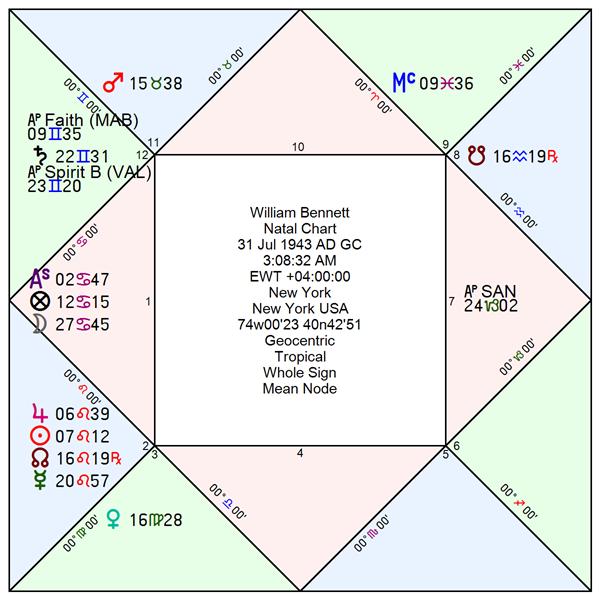
No Astrodatabank Record
Proposed Rectification: 3:08:31 AM, ASC 2CA47’45”
Permission: I grant the unlimited use of this rectified horoscope by the public. Credit ‘Regulus Astrology LLC’ and include an accompanying link to this webpage.
The analytical models used in the sections below are part of a larger research program developed across longer white papers and case studies, where the historical sources, rules, and testing methodology are laid out in full. These database entries show the models in practice; readers who want the theoretical foundations can start with the background papers below:
Rectification Hub (I wrote the book on it!)
Soul Hub (white paper, Victor model statistical tests, Moon’s Configuration studies)
Physiognomy Hub (white paper, examples)
Victor Model Factors favoring Venus/Virgo
Bound ruler: Sun, Lot of Fortune, Midheaven
Venus in Virgo, the sign of her fall, signifies difficulties involving morality, pleasure, and vice, which may manifest as either personal indulgence or an excessive concern with regulating the behavior of others. For William Bennett, the latter became the defining theme of his public career. As secretary of education, drug czar, and author of The Book of Virtues, Bennett sought to impose traditional moral standards upon American society, particularly concerning sexuality, drugs, and personal conduct. Venus is critically placed under the superior square of Saturn/Gemini, which signifies the enforcement of moral standards through rules, regulations, and institutional authority. Yet Venus in fall also suggests that the individual may struggle to escape the very temptations he publicly condemns. This contradiction became apparent in May 2003, when revelations of Bennett’s high-stakes gambling challenged his reputation as a moral authority. The nocturnal Firdaria sequence reinforces Venus as Victor: Bennett became drug czar under Sun/Venus in March 1989, while the gambling scandal erupted under Venus/Mars in May 2003. Together, these events illustrate the opposing expressions of Venus/Virgo: the public crusade against vice and the private difficulty of adhering to one’s own moral standards.
Physiognomy Model Factors favoring Gemini
Rising sign: Cancer
Ruler of rising sign: Moon/Cancer
Planets in rising sign: Moon/Cancer
During his peak years in the Reagan and George H. W. Bush administrations, William Bennett exhibited a solid, moderately stocky build, broad shoulders, and a substantial upper body. His face was relatively long and rectangular, with a broad forehead, prominent brow ridge, deep-set eyes, a straight and moderately prominent nose, and a firm, rather narrow mouth. The jaw was broad and well-defined, with a substantial chin and relatively straight sides to the face. His expression was generally serious and controlled, with a direct gaze and a slight tightening of the mouth that conveyed firmness. Although substantial in build, his facial structure was more angular than rounded. As Bennett aged, he gained considerable weight, producing a fuller face, heavier jowls, and a more rounded overall appearance.
Cancer is the rising sign, rising decan, and domicile of the Moon, which occupies the Ascendant. This concentration of lunar testimony might suggest the rounded face and softer bodily contours traditionally associated with Cancer, yet these characteristics were not especially prominent during Bennett’s peak years. They became more apparent with his later weight gain, which is consistent with Cancer’s tendency toward bodily fullness but less relevant to a physiognomy model emphasizing the prime of life. The critical distinction is that the Moon occupies the Egyptian bound of Saturn/Cancer, whose ruler Saturn is placed in Gemini. In Willner’s physiognomy model, Gemini corresponds to an elongated rectangular facial structure, characterized by relatively straight sides and greater facial length than width. This provides a reasonable match for Bennett’s earlier appearance, with Saturn contributing firmness, angularity, and a more severe expression. Thus, while Cancer and the Moon dominate the Ascendant by sign, decan, and bodily placement, Saturn/Gemini, operating through the Moon’s bound, offers the more convincing explanation of Bennett’s facial structure during his prime.
Moon’s Configuration
Stage 1. Moon Separating from Venus, Void-of-Course
Delineation. The Moon at 27°45′ Cancer separates from a sextile with Venus at 16°28′ Virgo, an orb of 11°17′ that exceeds William Lilly’s 9°30′ moiety for Moon–Venus aspects. The Moon is therefore void-of-course, with no further applying aspect before leaving Cancer. Venus in Virgo, the sign of her fall, signifies difficulties involving morality, pleasure, and vice, including prudishness or excessive concern with regulating personal conduct. The Moon’s separation suggests an early encounter with these Venusian themes, followed by a period in which they remain relatively undeveloped. The void-of-course condition indicates an interval of uncertainty or lack of direction before the Moon enters Leo and resumes its applications.
Biographical Match. Bennett’s Catholic upbringing, Jesuit education at Gonzaga College High School, and subsequent philosophical studies exposed him to questions of moral conduct, personal discipline, and virtue. However, these concerns did not immediately develop into the public crusade that later defined his career. During the 1960s and 1970s, Bennett pursued academic qualifications, taught philosophy, and worked in university administration. His appointment as executive director of the National Humanities Center in May 1976 continued this intellectual trajectory. The void-of-course interval may therefore describe a delay in the public expression of his Venusian concerns rather than an absence of personal or professional development.
Stage 2. Sun Applying to Jupiter
Delineation. The Sun/Leo applies to conjunction with Jupiter/Leo, bringing together solar consciousness and identity with Jupiter’s concern for religion, philosophy, law, and moral principles. Jupiter/Leo signifies the official creed of the nation, particularly the belief that society requires a common set of ethical and cultural standards. Both planets occupy the Egyptian bound of Venus/Leo, ruled by Venus/Virgo, connecting the formation of this creed directly to questions of morality, virtue, and vice. Jupiter is technically combust, but the condition is mitigated by its reception in the Sun’s domicile of Leo. The conjunction suggests an intellectual crystallization in which Venusian moral concerns become integrated into a coherent philosophy of national identity and personal purpose.
Biographical Match. Bennett’s education provides a plausible foundation for this configuration. His Catholic upbringing and Jesuit schooling were followed by philosophical studies at Williams College, a doctorate in political philosophy from the University of Texas, and a law degree from Harvard. His subsequent association with Boston University president John Silber, an outspoken defender of academic standards, further exposed him to debates over the purpose of higher education. These experiences helped shape Bennett’s conviction that education should transmit a common cultural and moral inheritance rather than merely provide technical instruction. His developing philosophy would later find expression in government policy, public speeches, and bestselling literature. At this stage, however, the emphasis is upon the formation of the creed within Bennett’s own intellectual framework, rather than its public imposition.
Stage 3. Moon Enters Leo
Delineation. The Moon’s departure from Cancer and entrance into Leo represents a change in the expression of the Venusian themes encountered earlier in her configuration. In Cancer, the Moon occupies her domicile, emphasizing emotional awareness, personal values, and the internal experience of morality. Upon entering Leo, she comes under the Sun’s rulership, shifting the emphasis toward public demonstration, leadership, and recognition. The moral concerns previously experienced at a personal and emotional level now seek outward expression. The change of signs also brings the Moon toward conjunctions with Jupiter and the Sun, establishing the conditions for the public manifestation of the philosophy developed through their earlier conjunction.
Biographical Match. Bennett’s early exposure to Catholic moral instruction and his subsequent philosophical education established a personal understanding of virtue, vice, and appropriate conduct. These concerns were initially expressed through intellectual inquiry and private conviction rather than national advocacy. The Moon’s entrance into Leo signifies the transition from an inward, emotionally grounded awareness of morality to its outward demonstration. Bennett increasingly sought to make his personal moral convictions visible to others, transforming questions of individual conscience into matters of public instruction and debate.
Stage 4. Moon Applying to Jupiter
Delineation. Following her entrance into Leo, the Moon applies to conjunction with Jupiter, activating the moral and philosophical principles previously established through the Sun–Jupiter conjunction. Jupiter/Leo signifies the proclamation of a national creed, while its placement in the Venus/Leo bound connects that creed to the regulation of Venusian matters involving virtue and vice. The Moon’s application indicates personal engagement in translating these principles into practical programs and public instruction. The emphasis shifts from intellectual conviction to the active promotion of a moral framework intended to guide society. Jupiter’s combustion is mitigated by reception from the Sun, linking these principles to established authority.
Biographical Match. Bennett’s government career demonstrates this translation of philosophy into action. His November 1984 report, To Reclaim a Legacy, advocated restoring a common cultural inheritance to higher education. As secretary of education, he promoted traditional virtues, academic discipline, and parental authority. His 1986–1987 disagreement with Surgeon General C. Everett Koop over AIDS education revealed his insistence that public-health instruction incorporate moral standards emphasizing abstinence and fidelity. As drug czar under George H. W. Bush, Bennett extended this approach to a national campaign against illegal drugs. These activities demonstrate the Moon–Jupiter application through the practical advancement of a creed that Bennett had already developed intellectually.
Stage 5. Moon Applying to the Sun
Delineation. After conjoining Jupiter, the Moon continues through Leo toward conjunction with the Sun. This final application transfers the emphasis from Jupiterian moral doctrine to solar fame, recognition, and public prominence. The Sun occupies the Egyptian bound of Venus/Leo, ruled by Venus/Virgo, reinforcing the connection between personal reputation and the regulation of morality, pleasure, and vice. In its own domicile, the Sun possesses considerable authority to realize the significations of the preceding Jupiter conjunction. The sequence suggests that public fame arises as a consequence of the individual’s advocacy of a moral or ideological program, with Venus/Virgo providing the distinctive subject matter of that fame.
Biographical Match. The publication of The Book of Virtues in November 1993 provides the clearest expression of this final application. Although Bennett had already achieved national prominence through his cabinet appointments, the book transformed his reputation from government official to bestselling author and widely recognized spokesman for traditional morality. Its commercial success generated additional volumes, children’s adaptations, and the PBS animated series Adventures from the Book of Virtues, which premiered in 1996. Bennett’s subsequent career as an author, political commentator, and nationally syndicated radio host extended this recognition. His fame remained closely associated with his advocacy of moral standards, even when later controversies challenged his personal reputation. The Moon’s final application thus describes the culmination of a progression from philosophical conviction to public advocacy and ultimately national celebrity.
Influence of Sect
The horoscope is nocturnal, placing Venus and Mars in-sect, while Jupiter and Saturn are out-of-sect. Venus/Virgo signifies concerns with morality, pleasure, and vice, while Mars/Taurus signifies the culture wars, in which competing values and traditions become sources of conflict. Both themes were prominent throughout American society during Bennett’s service in the Reagan and George H. W. Bush administrations, consistent with the greater prominence of the in-sect planets. Conversely, the out-of-sect condition of Jupiter and Saturn suggests difficulties in realizing their significations. Saturn/Gemini, overcoming Venus by superior square, represents Bennett’s attempt to regulate cultural behavior through institutional authority, while Jupiter/Leo signifies his advocacy of a national moral creed. Critics accused Bennett of exaggerating or even manufacturing a cultural crisis to justify government intervention, although the underlying social problems were genuine subjects of public debate. Nevertheless, his Saturnian efforts to impose moral standards generated considerable resistance, while his Jupiterian vision of a common national creed failed to achieve widespread acceptance. Thus, the in-sect planets describe the cultural conflicts that defined the period, while the out-of-sect planets signify the limitations of Bennett’s attempts to resolve them through regulation and moral authority.
Complete biographical chronology, rectification and time lord studies available in Excel format as a paid subscriber benefit. File is behind the paywall.