

Last week’s study of Microsoft co-founder Paul Allen provides a useful starting point for examining the horoscope of Bill Gates. Both men have Cancer rising, with the Moon in Aries occupying the tenth house and a malefic in the fourth. Yet their Moon’s Configurations differ in ways that help explain their contrasting careers. Allen’s Moon/Aries separates from Saturn/Libra before applying to the Sun/Aquarius, whereas Gates’s Moon/Aries has no operative separating aspect and applies directly to Mars/Libra by opposition. In Gates’s case, the ruler of the tenth house is itself the malefic occupying the fourth, introducing the possibility of a career whose achievements are accompanied by conflicts that eventually damage public standing. The federal antitrust proceedings against Microsoft provide one manifestation, but the configuration has implications extending well beyond Gates’s software empire.
Preparing this study prompted an unexpected extension of my recent research into Mars/Libra. In October, I published Mars in Libra: Fighting Over the Rules, using Steve Bannon as an example of how Mars in detriment can signify aggressive struggles over institutional arrangements, established rules, and the distribution of power. Gates presents another variation on this theme. Like Bannon, he has Mars/Libra in mutual reception with Venus/Scorpio. But Gates adds a close Venus–Saturn conjunction and a particularly revealing sequence of bound rulerships connecting Mars, Mercury, and Jupiter. These configurations help explain why contractual exclusivity became so important to Microsoft’s commercial strategy, and why the same struggles over institutional authority subsequently reappeared in a different form through the Gates Foundation. The distinction between the in-sect benefic Venus and the out-of-sect malefic Saturn is especially revealing: one makes commercial relationships attractive, while the other imposes restrictions that can ultimately undermine them.
Gates also belongs in my continuing Tech Bros series, with his Lot of Fortune occupying the bound of Saturn/Aquarius, the sign currently occupied by the North Node. The planetary conditions on Friday, November 20, when I was writing this study, offered another coincidence. The Moon’s conjunction with Saturn at approximately 8AR18 marked a lunar return for Gates, with both planets partile conjunct his natal Midheaven. Meanwhile, Jupiter at approximately 26° Leo was within two degrees of his natal Jupiter at 27LE47, the victor of the horoscope. Thus, while the Moon and Saturn revisited the very angle associated with Gates’s public reputation, Jupiter approached its natal position in the sign central to another of my ongoing research projects.
With Gates, I will also begin pivoting away from the recent concentration on technology executives and back toward my Jupiter/Leo series. Gates is an appropriate transitional figure. His Jupiter/Leo does not simply signify wealth, philanthropy, or public prominence. As victor of the horoscope, it raises questions about the conviction that one’s own beliefs possess sufficient moral and social authority to justify imposing them upon others. At Microsoft, that conviction found expression in the struggle to preserve Windows against competing technologies. Through the Gates Foundation, it raises a different set of questions concerning privately financed influence over public health, education, agriculture, and the media. The horoscope offers a way to examine the continuity between these seemingly different phases of Gates’s career—and to consider why the authority he has sought to exercise has repeatedly encountered substantial opposition.
Explore the complete collection of natal horoscope studies of mathematicians, scientists, and technology leaders in the Math, Science, and Technology Index.

William Henry Gates III was born on October 28, 1955, in Seattle, Washington, the son of William H. Gates Sr., a prominent attorney, and Mary Maxwell Gates, who served on several corporate and nonprofit boards. Raised in an affluent family, Gates attended the private Lakeside School, where he developed an early interest in computer programming and met Paul Allen, his future business partner. He entered Harvard University in 1973 but left without graduating to pursue opportunities in the emerging personal-computer industry.
In April 1975, Gates and Allen established Microsoft in Albuquerque, New Mexico, initially developing programming languages for microcomputers. Gates soon distinguished himself through his understanding of software licensing and the commercial possibilities of making operating systems available across competing hardware platforms. Rather than restricting Microsoft’s products to a single computer manufacturer, Gates pursued a model in which multiple manufacturers would depend upon Microsoft’s software.
The decisive opportunity arrived in 1980, when IBM approached Microsoft about software for its forthcoming personal computer. Microsoft acquired rights to an operating system developed by Seattle Computer Products, subsequently purchasing it outright and adapting it into MS-DOS. Crucially, Microsoft retained the ability to license the operating system to manufacturers other than IBM. As IBM-compatible computers proliferated, Microsoft’s software became an industry standard, establishing the foundation for its commercial dominance.
Microsoft went public on March 13, 1986, making Gates one of the wealthiest entrepreneurs of his generation. The company’s Windows operating system and Office productivity applications subsequently extended Microsoft’s influence over personal computing. By the 1990s, Gates had become the world’s richest individual and one of the most recognizable figures in the technology industry.
Behind the image of a brilliant young entrepreneur, however, Gates developed a reputation as an aggressive and frequently confrontational executive. Former colleagues described meetings characterized by intense questioning, criticism of proposals he considered poorly reasoned, and demands that subordinates defend their positions under pressure. His competitive philosophy extended beyond developing successful products to controlling the commercial relationships through which competing products reached consumers.
Microsoft’s licensing agreements became an important instrument of this strategy. Contracts with computer manufacturers limited their commercial flexibility and helped protect Microsoft’s operating-system position. In July 1994, following a federal investigation, Microsoft agreed to modify licensing practices that the Justice Department alleged had restricted competition. The agreement did not resolve the government’s broader concerns about the company’s market power.
The emergence of the internet introduced a new competitive threat. Netscape’s Navigator browser and Sun Microsystems’ Java technology offered the possibility of software operating across different computer platforms, potentially diminishing the importance of Microsoft’s Windows monopoly. Microsoft responded by integrating Internet Explorer into Windows and pursuing agreements with computer manufacturers, internet service providers, and software developers that restricted the distribution or promotion of competing technologies.
On May 18, 1998, the Department of Justice and state attorneys general filed a major antitrust action against Microsoft. The proceedings exposed internal corporate communications and business practices that contrasted sharply with Gates’s public image as an innovative entrepreneur. His videotaped deposition attracted particular criticism for evasive answers and disputes over the meanings of seemingly straightforward questions.
On November 5, 1999, federal judge Thomas Penfield Jackson issued findings of fact concluding that Microsoft possessed monopoly power in the market for Intel-compatible personal-computer operating systems and had used exclusionary practices to protect that position. In April 2000, the court found Microsoft liable for antitrust violations, and in June ordered the company divided into two businesses.
Although an appellate court overturned the breakup order in June 2001, it upheld the central finding that Microsoft had unlawfully maintained its operating-system monopoly through exclusionary conduct. A settlement with the Justice Department followed in November 2001. Microsoft’s defense of its commercial position had become a defining feature of Gates’s public career, complicating the earlier narrative that attributed the company’s success principally to technical innovation and entrepreneurial foresight.
On January 13, 2000, Gates announced that Steve Ballmer would succeed him as chief executive officer, while Gates would remain chairman and chief software architect. Although the change occurred during the antitrust proceedings, Gates presented the transition as an opportunity to concentrate on software development. He withdrew from full-time employment in June 2008, relinquished the chairmanship in February 2014, and left Microsoft’s board in March 2020.
Gates increasingly directed his attention toward philanthropy. He married Microsoft executive Melinda French on January 1, 1994, and the couple eventually established one of the world’s largest private charitable organizations. The Bill & Melinda Gates Foundation, formally consolidated in 2000, concentrated its activities on global health, poverty reduction, agriculture, and education. Warren Buffett’s 2006 commitment to donate substantial portions of his fortune expanded the Foundation’s financial resources.
The Foundation funded programs addressing malaria, tuberculosis, HIV/AIDS, childhood vaccination, and maternal and infant mortality. Its contributions helped support international vaccination programs and medical research, including initiatives directed toward diseases that had historically received insufficient commercial investment. These activities established Gates as an influential participant in international public health, earning recognition from governments, universities, and humanitarian organizations.
Yet the Foundation also introduced a different set of controversies. Its resources allowed Gates and a relatively small leadership group to influence public policy in fields where they possessed neither electoral authority nor direct accountability to the populations affected. Gates advocated technology-driven solutions, measurable outcomes, and partnerships with private corporations, approaches that critics argued sometimes subordinated local knowledge and alternative strategies to priorities established by wealthy donors.
The Foundation’s American education initiatives illustrate the difficulty of translating Gates’s managerial approach into public policy. Beginning in 2000, it invested heavily in the creation and restructuring of smaller high schools, based on the premise that reducing school size would improve educational outcomes. By 2009, Gates acknowledged that many participating schools had failed to produce significant improvements in academic achievement. The Foundation shifted its emphasis toward teacher effectiveness, evaluations, and educational standards.
The subsequent teacher-effectiveness initiative also produced disappointing results. A June 2018 evaluation by the RAND Corporation and the American Institutes for Research found that the program had not generated the anticipated improvements in student achievement or graduation outcomes. The Foundation discontinued direct investment in teacher-evaluation systems and redirected resources toward other approaches. Its support for the Common Core State Standards similarly attracted criticism from educators, parents, and political organizations concerned about privately financed influence over public education.
The Foundation’s agricultural programs generated comparable disagreements. The Alliance for a Green Revolution in Africa, launched in 2006 with support from the Gates and Rockefeller foundations, promoted improved seeds, fertilizers, and agricultural markets as instruments for increasing smallholder productivity and incomes. Critics argued that this approach favored commercial agricultural inputs and insufficiently accommodated local farming practices. An independent evaluation released in 2022 found that, despite improvements in some agricultural systems, the initiative had not achieved its headline objectives for increasing the incomes and food security of millions of smallholder farmers. Supporters nevertheless pointed to investments in agricultural infrastructure, seed distribution, and research capacity.
Questions about the concentration of philanthropic power became particularly significant in international health policy. The Gates Foundation developed extensive financial relationships with the World Health Organization and other multilateral institutions. Its grants could shape research agendas and program priorities, raising questions about the influence of private wealth over organizations formally accountable to national governments. Defenders of the Foundation emphasized the importance of its funding in areas where public resources were inadequate; critics questioned whether donor preferences received disproportionate influence over the allocation of those resources.
The Foundation also became an important financier of journalism. Grants supported reporting and communications initiatives involving organizations such as NPR, The Guardian, and the Pulitzer Center. In August 2020, investigative journalist Tim Schwab published an examination of these relationships in the Columbia Journalism Review, questioning whether news organizations receiving philanthropic funding could provide sufficiently independent scrutiny of their financial benefactor. The Foundation maintained that its grants preserved editorial independence. Nevertheless, the arrangements raised broader questions about the ability of private wealth to influence which issues receive sustained media attention and how those issues are framed.
These controversies were developed further in Schwab’s 2023 book, The Bill Gates Problem: Reckoning with the Myth of the Good Billionaire, which challenged the division between Gates’s earlier monopolistic business practices and his subsequent philanthropic reputation. Schwab argued that the concentration of economic power, confidence in privately designed solutions, and ability to influence institutions were recurring characteristics of both phases of Gates’s career.
Gates’s private life also became a source of public controversy. In May 2021, Bill and Melinda announced their divorce after twenty-seven years of marriage; the divorce was finalized that August. Subsequent reporting described Gates’s extramarital relationship with a Microsoft employee and concerns about his interactions with convicted sex offender Jeffrey Epstein. Gates acknowledged meeting Epstein after Epstein’s 2008 conviction and later described the association as a serious error in judgment.
The Epstein controversy continued into 2026. In February, Gates apologized to Foundation employees for his association with Epstein and acknowledged extramarital affairs. In June, he answered questions from a congressional committee investigating Epstein’s relationships with prominent individuals. An external review commissioned by the Foundation subsequently examined its contacts with Epstein and found that institutional safeguards had failed to respond adequately to warning signs. The review reported no evidence that the Foundation made payments to Epstein. The episode nevertheless raised additional questions about Gates’s personal judgment and the governance of an institution closely associated with his reputation.
Melinda French Gates resigned as co-chair of the Foundation in June 2024, following the couple’s divorce and the separation of their philanthropic activities. Under their agreement, she received $12.5 billion for independent charitable work focused on women and families. Gates remained the Foundation’s chair, with the organization subsequently adopting the simplified name Gates Foundation.
the following twenty years and permanently close on December 31, 2045. The decision represented an acceleration of his plans to distribute most of his remaining wealth during his lifetime. In January 2026, the Foundation approved a $9 billion annual payout, continuing its emphasis on global health, nutrition, maternal care, and the development and distribution of medical technologies.
Gates has also become increasingly active in discussions concerning artificial intelligence, climate change, energy technology, and the economic consequences of automation. His advocacy of technological innovation continues to reflect the conviction that difficult social and scientific problems can be addressed through research, investment, technical expertise, and the coordinated activity of major institutions.
The historical assessment of Bill Gates remains inseparable from the two institutions through which he exercised influence. Microsoft helped establish the modern personal-computer industry while engaging in exclusionary practices that federal courts found unlawful. The Gates Foundation has financed extensive humanitarian and scientific work while generating continuing debate about the accountability of private philanthropy, the influence of wealthy donors over public policy, and the results of costly initiatives that did not fulfill their original promises.
Gates’s career therefore presents more than the familiar progression from software entrepreneur to humanitarian benefactor. It is also the history of an individual whose extraordinary financial resources gave him sustained influence over commercial markets, scientific research, public institutions, and international development. Whether exercised through corporate contracts or philanthropic grants, that influence has repeatedly raised the question of how much authority should be concentrated in the hands of a private individual, even one convinced that his objectives serve the public good.
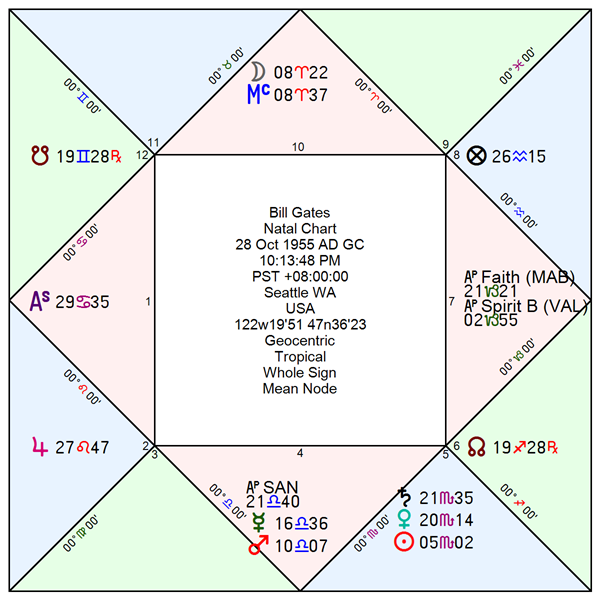
Rodden Rating A, From memory, 10:00 PM, ASC 26CA58
Proposed rectification (2020), 10:13:48 PM, ASC 29CA35’09”
Permission: I grant the unlimited use of this rectified horoscope by the public. Credit ‘Regulus Astrology LLC’ and include an accompanying link to this webpage.
The analytical models used in the sections below are part of a larger research program developed across longer white papers and case studies, where the historical sources, rules, and testing methodology are laid out in full. These database entries show the models in practice; readers who want the theoretical foundations can start with the background papers below:
Rectification Hub (I wrote the book on it!)
Soul Hub (white paper, Victor model statistical tests, Moon’s Configuration studies)
Physiognomy Hub (white paper, examples)
Big Three (Sun sign = Scorpio, Moon sign = Aries, Rising sign = Cancer)
Victor model factors favoring Jupiter/Leo
Overcomes Saturn by the superior square aspect, receives Saturn by bound
7th from Lot of Fortune
Saturn initially appears to be a promising candidate for victor, ruling both the Lot of Spirit and Lot of Fortune by sign, as well as the Ascendant and Lot of Fortune by bound. However, Saturn at 21SC35 occupies Jupiter’s bound, with its bound lord Jupiter at 27LE47 overcoming Saturn by superior square. This technical condition is sufficient to establish Jupiter/Leo as victor of the horoscope, providing another example of how reception by bound alone is sufficient to perfect reception. Jupiter/Leo signifies the conviction that one’s beliefs possess overriding moral, political, and social authority, such that competing viewpoints are regarded not merely as alternatives but as errors requiring correction or elimination. This tendency can be observed in Gates’s monopolistic practices at Microsoft, where Netscape’s competing browser technology was treated as a threat to the established Windows order that had to be neutralized. The same Jupiter/Leo principle offers a framework for understanding Gates’s top-down approach to philanthropy, in which privately determined solutions have frequently taken precedence over local knowledge and feedback from those directly affected by Foundation initiatives. In both cases, Jupiter/Leo expresses a conviction in the correctness of one’s own judgment, coupled with the financial and institutional power to impose that judgment upon others.
Physiognomy model factors favoring Leo
Rising sign: Cancer
Ruler of rising sign: Moon/Aries
Rising decan: Pisces
Ruler of rising decan: Jupiter/Leo
Photographs of Bill Gates from the 1990s, when he was in his late thirties and early forties, reveal a relatively lean physique, with a narrow torso and little evidence of excessive flesh. His face is moderately elongated, with a broad upper forehead, relatively straight nose, thin to moderately full lips, and a well-defined lower jaw. The jaw outlines a roughly rectangular face, although the overall facial structure is neither conspicuously round nor heavily fleshed. Gates has maintained a generally lean appearance into his later years, suggesting that the characteristics visible in the 1990s were not merely the consequence of youth. The photographs are particularly useful because they fall within the preferred testing interval for this physiognomic model, from the late twenties through the middle or late forties, when mature physical characteristics are established without being substantially altered by advanced age.
Leo appears to be the principal physiognomic significator, particularly in the rectangular outline of Gates’s lower face and relatively defined jaw. The correspondence is less convincing in body type, since Leo is often associated with a shorter, more compact, Napoleon-like build, whereas Gates is comparatively tall and lean. Aries may contribute to the slender physique through the Moon, ruler of the Cancer Ascendant, occupying Aries, although his face does not exhibit the bony, ovate structure associated with Aries in John Willner’s model. Consequently, Leo remains the preferred significator, represented by Jupiter/Leo, ruler of the Pisces rising decan and victor of the horoscope. This is a useful case in which the planetary rulers appear more descriptive than either the rising sign or rising decan considered independently. Cancer rising and Pisces as the rising decan are both associated with larger torsos, rounder faces, greater fleshiness, and, particularly for Pisces, a double chin—characteristics that are not prominent in Gates. However, the rulers of both are placed in fire signs: the Moon in Aries and Jupiter in Leo. Their fiery placements may account for the reduction in flesh that would otherwise be expected from Cancer and Pisces, while Jupiter/Leo supplies the more convincing rectangular facial outline. The result favors Leo without requiring an equally strong correspondence to every traditional Leonine characteristic.
Moon’s Configuration
Stage 1: Moon Separating from Saturn — Rejected
Delineation: The Moon at 8AR22 has separated from a trine to Saturn at 21SC35, but the aspect is both out of sign and outside the permitted orb under Lilly’s moiety rules. Consequently, Saturn is excluded as an operative separating aspect in the Moon’s Configuration. There is no reason to infer that Gates’s childhood began under a dominant Saturnian influence from which he subsequently escaped. Instead, the Moon in Aries, partile conjunct the Midheaven and representing the mother, is already applying to an opposition with Mars in Libra. This suggests that the Moon–Mars conflict was present from the beginning rather than emerging after an earlier period of Saturnian restraint.
Biographical Match: Gates’s childhood provides evidence for this distinction. In his 2025 memoir, Source Code: My Beginnings, Gates describes persistent conflicts with his parents, particularly his mother, Mary Gates. Beginning around age nine, he challenged family rules and resisted his mother’s expectations concerning obedience, manners, and social responsibilities. Family arguments sometimes became heated, including an occasion when his normally patient father threw a glass of water in his face. Around age twelve, his parents arranged psychological counseling to address his defiant behavior. Gates subsequently described the counseling as beneficial and credited both parents with supporting his development. There is little documentary evidence of an oppressive paternal authority dominating his early life. Instead, his mother’s efforts to impose rules encountered the resistance of an unusually independent and combative child. This is consistent with the Moon/Aries conjunct the Midheaven representing the mother, while Gates himself assumes the oppositional role of Mars. The Moon–Mars configuration is already fully expressed in childhood, without requiring an earlier Saturnian phase.
Stage 2: Moon Applies to Mars (Libra, 4th house)
Delineation: The Moon at 8AR22 applies to the opposition of Mars at 10LI07, its own domicile ruler. Mars is in detriment in Libra, occupying the fourth whole-sign house while ruling Aries on the tenth. This places the ruler of career and reputation in the house opposite its own, suggesting difficulties concerning public standing, professional authority, and the eventual outcome of one’s career. Mars/Libra signifies conflict over the rules governing relationships, contractual obligations, commercial alliances, and the distribution of power. Rather than relying upon direct confrontation, Mars pursues its objectives through legal arguments, negotiations, agreements, procedural maneuvering, and restrictions imposed upon competitors. Mars occupies Mercury’s bound, with Mercury itself in Libra, further emphasizing the use of language, legal interpretation, and contractual provisions as instruments of competition.
Mars is also in mutual reception by domicile with Venus in Scorpio, introducing possessiveness, jealousy, and the desire for exclusive relationships. In a commercial setting, Venus/Scorpio’s jealousy can manifest as the demand for exclusive contractual arrangements that prevent valuable business partners from dealing with competitors. The scorpion’s pincers offer an appropriate metaphor: once a relationship has been secured, Venus/Scorpio seeks to retain possession and resists the possibility of its escape. Venus’s close conjunction with Saturn adds restrictive and enforceable conditions to these relationships. The resulting configuration describes a struggle for commercial dominance through the control of relationships, agreements, and the rules under which competitors are permitted to operate.
Biographical Match: Gates’s management of Microsoft provides a sustained expression of these principles. Microsoft’s early licensing arrangements with IBM allowed the company to retain rights to distribute its operating system to other manufacturers, establishing the basis for its subsequent dominance of the personal-computer industry. As Microsoft expanded, its contractual relationships increasingly became instruments for preserving its competitive position. Agreements with computer manufacturers restricted their ability to modify Windows or promote competing products, while Microsoft’s browser strategy sought to neutralize Netscape Navigator, whose independence threatened the operating system’s central position in personal computing.
These practices became the subject of federal antitrust proceedings beginning in 1998. In June 2001, the federal appellate court upheld the finding that Microsoft had unlawfully maintained its operating-system monopoly through exclusionary conduct. Gates’s own testimony attracted criticism for its evasive and argumentative character, illustrating the Mercurial dimension of Mars/Libra: legal combat conducted through the interpretation of words, definitions, and contractual provisions.
The fourth-house placement of Mars, ruler of the tenth, also corresponds to the professional consequences. Microsoft’s commercial arrangements, which had helped establish Gates’s authority, became the foundation of legal challenges that damaged his public reputation. Although the company’s breakup order was overturned, the proceedings exposed the restrictive practices underlying Microsoft’s market position. Gates relinquished the CEO position to Steve Ballmer in January 2000, subsequently withdrew from full-time employment in 2008, and eventually left Microsoft’s board in 2020. The ruler of the tenth in the fourth thus signifies not simply legal conflict, but the transformation of Gates’s professional position through challenges to the institutional foundations of his career.
Stage 3: Moon Applies to Mercury (Libra, 4th)
Delineation: After opposing Mars, the Moon continues through Aries and applies to the opposition of Mercury at 16LI36. Mercury occupies Jupiter’s bound and rules the bound of Mars. This connects the competitive activities of Mars/Libra to communication, journalism, public argument, the circulation of information, and attempts to influence opinion. Mercury/Libra is concerned with competing viewpoints and the relationships among institutions that produce and distribute information. Its opposition to the Moon suggests that public discourse itself can become contested territory, with efforts to influence the terms of debate and the relative prominence of competing perspectives. Because Mercury occupies Jupiter’s bound, these activities are connected to the moral, political, and social authority represented by Jupiter/Leo, the victor of the horoscope.
Biographical Match: The Gates Foundation’s extensive financing of journalism and communications provides an example of this configuration. Investigative journalist Tim Schwab documented the Foundation’s grants to numerous news organizations, including NPR, The Guardian, and other outlets whose reporting encompasses the same global-health, education, and development policies supported by the Foundation. Grants have also supported specialized journalism organizations and reporting initiatives, helping determine which subjects receive sustained attention from journalists and their audiences.
These arrangements create a potential conflict between the public interest in independently reported information and the financial interests of institutions receiving philanthropic support. Although the Foundation maintains that its grants preserve editorial independence, critics have questioned whether dependence upon a wealthy donor can influence editorial priorities or discourage scrutiny of the donor’s activities. Financial support does not by itself establish editorial control or an exchange of favorable coverage for funding. Nevertheless, the funding of communications institutions provides a means of amplifying particular subjects and policy priorities. Within the Moon–Mercury opposition, public opinion becomes another field of institutional competition, with Mercury/Libra supplying the mechanisms through which information and argument are organized.
Stage 4: Venus applies to the conjunction of Saturn (Scorpio, 5th)
Delineation: Although this stage is not itself an aspect made by the Moon, Venus at 20SC14 applies to the conjunction of Saturn at 21SC35. Venus is in detriment in Scorpio and in mutual reception by domicile with Mars/Libra. Venus/Scorpio introduces intense attachment, possessiveness, jealousy, sexual desire, rivalry, and the possibility of retaliation when an exclusive relationship is threatened or broken. Saturn adds restriction, prohibition, enduring obligations, fear of loss, and institutional mechanisms designed to preserve established arrangements. In commercial relationships, the conjunction can signify the transformation of Venusian attachments into binding contractual obligations, including demands for exclusivity and restrictions upon competitors.
Saturn occupies Jupiter’s bound, with Jupiter at 27LE47 overcoming Saturn by superior square. Consequently, Saturn’s restrictive activities are received by Jupiter/Leo, the victor of the horoscope. Within this configuration, restrictions may be justified as necessary to preserve an established order regarded as morally or institutionally legitimate. Venus seeks to retain possession, Saturn establishes the prohibitions that protect it, and Jupiter supplies the higher authority under which those prohibitions are justified. The conjunction thus links private desire and commercial exclusivity to broader questions of control, institutional security, and the defense of an established system.
Biographical Match: Microsoft’s restrictive licensing arrangements provide a commercial manifestation of the Venus–Saturn conjunction. Relationships with computer manufacturers were economically valuable because Windows had become the dominant operating-system platform. Microsoft’s efforts to prevent manufacturers from distributing or prominently displaying competing technologies helped preserve those relationships and restrict the opportunities available to rival software companies. The antitrust proceedings documented how contractual restrictions could protect an established monopoly rather than simply facilitate ordinary commercial cooperation.
A more personal expression of the Venus–Saturn themes appears in Gates’s marital and professional relationships. In 2021, Gates and Melinda French Gates announced their divorce after twenty-seven years of marriage. Reporting also established that Gates had engaged in an extramarital relationship with a Microsoft employee, which later became the subject of institutional scrutiny. These events provide documented examples of sexual relationships becoming entangled with professional obligations, reputation, and institutional consequences. They do not establish jealousy or revenge as Gates’s personal motives, but they offer a more literal manifestation of the difficulties associated with Venus in Scorpio applying to Saturn.
The Foundation’s grantmaking relationships provide a further institutional analogy. Financial support can create enduring dependencies between the donor and recipient organizations, sometimes raising questions about their independence and ability to challenge the donor’s preferred policies. Such relationships are not equivalent to monopolistic contracts, but they illustrate how valuable partnerships can become entangled with conditions, institutional obligations, and unequal bargaining power.
Stage 5: Moon Applies to Jupiter (Leo, 2nd house)
Delineation: Following its oppositions to Mars and Mercury, the Moon continues through Aries and applies to the trine of Jupiter at 27LE47. Jupiter/Leo is the victor of the horoscope and signifies the conviction that one’s beliefs possess moral, political, or social authority and therefore establish standards against which competing beliefs and practices are judged. At the institutional level, it can signify an effort to organize society around a preferred system of values, with opposition regarded not merely as disagreement but as error requiring correction. Jupiter occupies Mars’s bound, while Mars occupies Mercury’s bound and Mercury occupies Jupiter’s bound, producing a closed circuit connecting competition, communication, and ideological authority. The Moon’s final application to Jupiter thus brings the preceding conflicts over relationships, contracts, and public discourse into the sphere of moral and institutional legitimacy.
Biographical Match: Gates’s career illustrates this Jupiter/Leo principle through both Microsoft and his philanthropic activities. At Microsoft, Gates pursued a strategy in which Windows became the organizing platform for personal computing, while competing technologies such as Netscape Navigator were treated as threats to the established system. The resulting commercial conflicts culminated in federal antitrust judgments against Microsoft, demonstrating how the protection of an established technological order could become incompatible with competition law.
Through the Gates Foundation, Gates subsequently exercised influence in education, agriculture, international health, and development policy. Its programs frequently emphasized technical expertise, measurable outcomes, centralized planning, and solutions selected by its leadership. Critics have argued that this top-down approach sometimes gave insufficient weight to local knowledge, independent expertise, and feedback from populations directly affected by Foundation initiatives. Its American small-schools and teacher-effectiveness programs produced disappointing results despite substantial financial commitments, while its agricultural-development initiatives generated disputes over the appropriateness of commercially oriented solutions for smallholder farmers.
These outcomes do not establish that Gates personally dismissed all contrary evidence; indeed, the Foundation revised or discontinued initiatives after unfavorable evaluations. They nevertheless provide a basis for examining the Jupiter/Leo symbolism of moral and institutional authority: the conviction that privately selected solutions can be applied across large populations through the financial resources and organizational power available to their sponsor. The Moon’s trine to Jupiter suggests that the culmination of Gates’s public life is not merely the defense of commercial interests, but the pursuit of a broader authority to define social priorities and prescribe solutions to public problems.
Influence of Sect
Gates’s horoscope is nocturnal, placing Mars and Venus in sect, while Saturn and Jupiter are out of sect. Mars/Libra, although in detriment, is the in-sect malefic, moderating its destructive potential and allowing Gates’s aggressive negotiating tactics and monopolistic business practices to produce substantial commercial success. Venus/Scorpio, while in detriment, remains the in-sect benefic. Its mutual reception with Mars facilitates the pursuit of exclusive commercial relationships, while its in-sect status makes their restrictive provisions more palatable to Microsoft’s business partners. However, Venus applies to the conjunction of Saturn/Scorpio, the out-of-sect malefic, fundamentally changing the character of these relationships. What begins under Venus as an attractive commercial partnership becomes, under Saturn, a restrictive arrangement designed to prevent competition, preserve exclusivity, and prohibit partners from pursuing alternative relationships. Saturn/Scorpio introduces the scorpion’s fear of losing its prey, imposing contractual restraints upon relationships that Venus initially helped secure. As the out-of-sect malefic, Saturn is more troublesome than Mars, and its prohibitive activities eventually produced consequences that Venus could no longer ameliorate, culminating in Microsoft’s antitrust proceedings.
Saturn occupies Jupiter’s bound, with its bound lord Jupiter/Leo overcoming Saturn by superior square, connecting these restrictive practices to the victor’s conviction in the legitimacy of an established order. Yet Jupiter itself is the out-of-sect benefic, limiting the wider social acceptance of Gates’s efforts to impose his preferred commercial and philanthropic systems. Microsoft’s monopolistic practices encountered federal intervention, while the Gates Foundation’s top-down initiatives have attracted sustained criticism concerning their effectiveness, accountability, and influence over public policy.
Complete biographical chronology, rectification and time lord studies available in Excel format as a paid subscriber benefit. File is behind the paywall.